




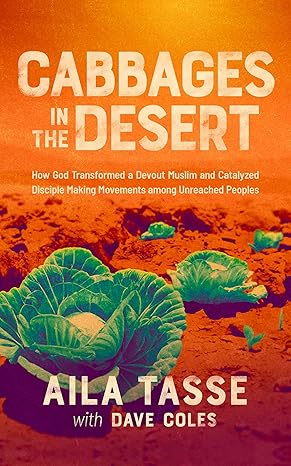



– Reach out if there’s a book you think should be added to the list! – [email protected]

– Originally posted in Mission Frontiers on 9.1.24 as “Many Small Victories: What’s Really Happening in Movements
24:14 Goal: Movement engagements in every unreached people and place by 2025 (16 months)” by Roger Charles –
A long, dark line runs up the corner of my house; from a distance, it looks like a power cable going up the wall. But a closer look reveals that the black line is a thick trail of ants, carrying food from the field up into a corner of my attic! Many Christians who have heard of church planting movements or disciple making movements misunderstand at a deep level what those movements really consist of. They read descriptive summaries, perhaps including large numbers of disciples and churches, and they envision something large, something powerful. When we hear of a church of 5,000 members, we think of a big auditorium on a big campus. But movements generally consist of clusters of house churches, with some lay elders overseeing a dozen or so home groups. They are much more like the trail of ants than a 220-volt power main. Although small, they are alive. And they are getting a job done.
In most movements to Christ around the world today, nothing really large ever happens in one place at one time. Movements involve ordinary people talking with other ordinary people—caring about what they care about, connecting with their group, and then connecting their group to God’s Word. Movements employ a handful of ministry patterns so simple that other regular people can easily imitate them and persist in doing them even while suffering persecution.
When we read Joshua 10 and 11, describing Joshua’s many victories in the land of Canaan, we can easily get the impression of one total victory following directly on the heels of another. But Joshua 11:18 gives a quick peek behind the scenes to glimpse many years of a more complex reality: “Joshua waged war against all these kings for a long time.” This wasn’t a quick string of one-day battles; the Lord has briefly summarized a long process. And while most of the narrative describes Joshua as the prime actor leading Israel’s battles, five verses specify the more diverse reality: “Joshua and all Israel with him” (Josh 10:29a, 31a, 34a, 36a, 38a NIV). The text does present a series of big wins, but a closer look reveals that those big wins consisted of many small victories, by all the families of all the tribes.
A disciple making movement doesn’t become a movement because a famous preacher comes into town to speak to 500 people or 2,000 people. A movement grows when a couple of neighbors, who often hang out together anyway, gather to discuss a Bible passage together. And then another, and another. When friends make a habit of sharing their problems with one another and discussing them in the light of God’s Holy Books, they gain some momentum in the right direction. They might meet for six months or a year before somebody outside the group gets interested enough to start a similar group. But what if a few of those little groups multiply in a year, and that happens in five, then 10, then 100 places? If in 100 places one group becomes two groups, which become four groups, that suddenly equals 400 groups. If each gathering averages just five attendees, 400 groups of five people equals 2,000 people: a significant total.
Movements consist of Jesus doing family-sized things with groups of friends in many places at once. And those family members care enough about a neighbor or another family member to do the same simple thing again. Not many people can lead a group of 100 or even a group of 50. But if a process is very simple, anybody can do it. Everyone can talk to two or three friends. Simple things multiply easily. A person doesn’t have to be a great leader to talk to a few relatives, or to start a couple of new groups among neighbors. Anybody could do that.
Anybody is doing that. Every week we hear about another neighborhood where somebody went in and said, “Do you want to have a group like ours?”
People say, “Sure. Can I join your group?”
“No, sorry, our group is already full. But I can help you start your own group if you can pull some friends together.” In that way, they might start two or three new groups in a month, with no one pressuring anyone. People like to join something local and interesting.
We need to understand how movements grow, both wider and deeper. The everyday growth just described takes a movement deeper within a particular group. As Donald McGavran observed, the gospel tends to spread best within a homogeneous group. People normally communicate with and trust people like themselves. But we have seen many modern movements grow beyond this communication barrier. While they spread most rapidly within specific segments of society, the message also jumps to spread widely among other distinct groups. We call that jump-over fruit, which happens most commonly in one of four ways: Gifted Men/Women, Miracles, Marriage, and Migration.
The Lord gives gifts to his people, as described in Ephesians 4:11–13. The first gift listed is that of an apostle: a special gift for sharing the gospel in new areas and among different groups. Those with such gifts bridge the gap between the way their own group thinks and the way another group thinks. They overcome barriers of language, culture, ethnicity, and/or geography to get something started and lay a foundation for others to continue the harvest.
Sometimes a miraculous event happens, and many people suddenly come to faith. A crippled woman gets healed, a boy gets delivered from a demon, or an old man has a dream, and many lives are touched. Those stories easily get gossiped across neighborhoods and can stir up sudden interest in Jesus. Sometimes gifted people or special acts of God help a movement start in a new spot, then once the first fruit has taken root, it spreads like a vine, and generation after generation of new fruit can grow.
However, jump-over fruit also happens in two ordinary ways, through marriage and migration. When someone marries across the boundaries between “us” and “them,” God may open a door for the gospel to slip through a cultural barrier. At other times, the gospel spreads through migration. A believer may find a new job in a new place. Or a sharp student from a backwoods region goes off to college, where Jesus awaits. Then he or she takes the news back home, and the first fruits start growing in a new ethnic group.
All four of these common kinds of jump-over fruit are relatively small: one miracle, one woman’s marriage, one worker’s job change, and one gifted person sharing one more time. But they model something others can copy. They replicate an easy meeting pattern, nudged along by the Holy Spirit through a small booklet of Bible verses or an app on a phone. The new circle of relationships presents an opportunity for the gospel to spread from “us” to “them.” When a more mature disciple maintains a strong relationship with the person who has entered a new sphere of influence, they can pray for that small circle and mentor them to multiply new circles in the new context. Even new believers can pass on the treasure from God’s Word: God’s good answers to life’s hard questions. Each small victory has the potential to become a bigger victory.
In everyday life, most people in a huge movement don’t think they’re part of something huge. They just know they’ve entered a new way of life and have the privilege of sharing that life with a few others. They certainly don’t see themselves as part of a big giant machine. They just share good stuff with a few friends: “Hey, can I tell you this great story I heard about one of the prophets?” Inside the movement, these small victories continue to happen. As long as the daily bread of biblical truth and life-on-life maturing continues, the battles with sin and Satan can be won, and the good news keeps spreading. The victories consist of growing new life in Christ even more than the number of new disciples.
In some church models, success means hundreds or thousands of people gathering. People say, “That guy’s such a great preacher, I’d drive all the way across town to hear him preach every week.” By contrast, a small victory involves asking a friend, “What did you learn last week about Jesus?” or “Is there anything I can do for you this week?” A little love, a little truth, and a little faith grow day after day. These small victories consist of people studying God’s Word, considering its application for their lives, putting it into practice, and talking with others about it. Small victories like these happen every day throughout a movement.
People want to join other families that keep getting healthier, to become part of a team that keeps encouraging their neighbors. The kingdom of heaven means people follow the patterns of the King, living by the King’s rules with the King’s people and power. New disciples learn kingdom patterns by studying Scripture and watching “older brothers and sisters” in the kingdom.
These patterns in day-to-day life help ensure that God’s Word stays at the center. Disciples listen to God’s Spirit and concretely display real love for hurting people around them. When Jesus’s disciples do these things again and again, they win small victories—in dozens, hundreds, and eventually thousands of neighborhoods. My neighbor walked into my home yesterday and shared about a movement he monitors where substantial societal change is happening. Transformed lives have always been the cutting edge of the church’s witness. Outsiders notice the small victories and some of them want to join. This displays the priesthood of all believers in action: Every member of God’s kingdom can welcome new people to come and see the King.
Jesus offers a positive, healthy, abundant life, amid a dark world. A movement doesn’t happen because of good advertising, good branding, or big media campaigns. It happens because of the everyday life “advertisement” of believers’ openness to interact with a few people and let them see the King at work in their lives. It happens through the work of God’s Spirit—in both the joys and the sorrows of the disciples’ lives.
I’ve trained teams of experienced field workers, who have served for years hoping something big would happen, but most see very little. When I showed them how a group of simple housewives were starting groups, that started groups, that started more groups, it inspired hope. They realized “If we only need little victories like that to start a movement, maybe we could do this.” Once they aimed to start something that other people could do on their own, things began to change. After about a year of slow but steady growth, six or eight groups of five became more fruitful than in any previous year. And the year after that brought even more growth!
A paradigm shift occurs when college-trained pastors realize: “We can release housewives to do this. We can release carpenters and bricklayers to do this. We can have teenagers do this.” As long as they stay centered on God’s Word and are looking outward to share with the lost, the movement grows. Many organizations in our country have now realized this and are experiencing slow but steady multiplication.
Some chapters of Joshua describe great victories, actually summarizing many years’ worth of small victories. We can only imagine the thousands of regular guys who got up every morning to go do hand-to-hand combat once more. They faced countless small fights which, added all together, turned into something big.
We may find it convenient and exciting to share summaries of many new disciples coming to faith and many churches being planted in a movement. But those descriptions can mislead if we don’t clarify that the actual progress consists of many small and often hard-earned victories. Real progress happens through any number of ordinary disciples applying simple kingdom patterns that easily multiply. Jesus calls us to do small kingdom things, with mustard-seed-sized faith.
That kind of description can convey a more accurate, more believable, and more doable, narrative of God’s work in movements. The big picture is true and worth knowing, but we need to join and live out the adventure of many small victories.

– Originally posted in Mission Frontiers on 4.30.24 as “How God Transformed a Devout Muslim and Catalyzed DMMs among UPGs” by Dave Coles –
Aila Tasse began attending the mosque at an early age. Raised in a strong Muslim family in northern Kenya, he took his Islamic studies seriously and avoided Christians. At around the age of nine, he developed a deep desire to know more about his Islamic faith. He started spending time with the elders after each day’s afternoon prayers, listening to them discuss the Qur’an and other issues. But a question gnawed at Aila’s heart: Who is Allah?
Through unexpected and terrifying circumstances, God opened Aila’s heart to receive the gospel and Christ’s forgiveness. Aila describes the details of this radical transformation in Cabbages in the Desert: How God Transformed a Devout Muslim and Catalyzed Disciple Making Movements among Unreached Peoples. The following are two excerpts adapted from this book.
One day, I [Aila] summoned my courage and boldly asked the Lord, “God, I want to have an appointment with you. I want to hear you. I want you to lead me.” A week later, I went to a campsite in the Marsabit forest to pray in solitude. I sat on the ground, leaned against a tree, and closed my eyes to pray, putting my Bible on the ground next to me. Suddenly, I felt such a strong presence of God that the environment around me totally changed. I thought to myself, “God is here!” I was terrified and didn’t dare to open my eyes. I thought, “I asked God to give me an appointment and now he’s here! I can’t open my eyes because if I see him, I’ll die!”
While praying in his presence, I had a dramatic vision that lasted for many hours and came in three parts.
The first was like a slideshow. A screen opened before me, and to my astonishment, I saw the imam of our home mosque. As I fixed my eyes on him, a kind, strong voice said to me, “Forgive him. Bless him and pray for him.” He had hurt me the most when I was persecuted and banished from my family. Now I was being asked to forgive, bless, and pray for him! I couldn’t understand the purpose. I struggled in my thoughts and weighed whether to obey the command of that clear voice. I finally chose to obey. I prayed for and blessed the imam until I had no words left. Then his face disappeared, and another took its place.
One by one, all who had hurt me appeared on the screen, and I repeated the process for each one. Each time I did, I felt like an arrow, once buried in my heart, was removed and, with it, bitterness and hatred evaporated.
The second part of the vision came like scenes in a movie theatre. But I wasn’t just watching; I was a key actor in the drama. I watched the back of a person walk down the road. He turned right before sitting near a potter at work. I didn’t see the potter’s face, only his hands working the clay. The clay broke in his hand as he worked, and a voice said to me, “You see that? You are the one sitting there watching the potter.” He told me, “I am the Potter, you are the clay, and I will make you.”
The vision then moved to the third part. I saw myself in a place I recognized as the Dida Galgalu Desert, a part of the Chalbi Desert in northern Kenya between Moyale and Marsabit. This desert is so barren that it has only one small tree nicknamed Tigo. This is a point of reference when crossing the desert. In my vision, I saw the vast emptiness of this dry and rocky desert. Then, I heard a question in my ears, “Can cabbage grow in this desert?”
I said to myself, “How could cabbage grow here? There’s no grass, nothing! Nothing grows in this desert!” At that point, the vision seemed to stop. I stood up to stretch and realized almost three hours had passed. I sat back down to pray, and suddenly the vision resumed. I again saw the Chalbi Desert. This time the voice did not ask a question. Instead, a male voice made a statement, “Cabbage can grow in this desert.” Suddenly, I saw rows of healthy cabbages growing in it!
Along with this, Isaiah 43:18–20 came to mind: “Forget the former things; do not dwell on the past. See, I am doing a new thing! Now it springs up; do you not perceive it? I am making a way in the wilderness and streams in the wasteland. The wild animals honor me, the jackals and the owls, because I provide water in the wilderness and streams in the wasteland” (NIV). The Lord’s words echoed a prophetic application: “I will cause these rivers to grow cabbages in the desert.”
As abruptly as the visions had begun, this third vision ended. As my mind cleared, I realized it was about 5:00 p.m. and elephants were grazing close by me! I had not heard them approach. At some distance, I saw two game wardens watching, probably worried for my safety but not knowing how to alert me without alarming the animals, lest they panic and charge toward me. The elephants, however, were not bothered by my presence and continued breaking branches as they ate. So I quietly took my Bible and walked away, choosing a path away from them and toward home.
The vision of cabbages in the desert stuck in my mind, and I prayed about it for weeks. Finally, the Lord gave me understanding. The arid northern parts of Kenya are home to tribes like the Gabra, Rendille, Borana, Burji, and Daasanach, all classified (currently or until recently) as unreached people groups (UPGs). Reaching them is difficult because they live in remote, difficult-to-reach areas. Poor infrastructure in that region remains a great challenge, even up to the present. Fourteen of the 26 unreached people groups in Kenya live in that desert, the exact desert where I saw the cabbage growing. I began to pray specifically about those people and tribes. It became clear to me that this was my calling. Bringing these people groups into God’s kingdom was the “new thing” God was going to do. I began reaching out to the UPGs in that region.
The Lord orchestrated yet another life-changing experience for me. World Vision asked me to help distribute food to the Rendille people in Lontolio village after rains failed to come the previous year. Lontolio lies outside the town of Laisamis, home to many pastoralist communities, near a sacred hill locally called “The House of God.”
In circumstances like these, safety is paramount. Distributions require good cooperation with local administrative officials. Three of us went ahead to assess the situation before the team and the food truck arrived. In the area designated for food distribution, scattered around acacia trees, huddled in small groups, we found about 200 men and women. They seemed engaged in deep conversation, probably about their predicament.
Looking at the small crowd, I saw an opportunity to preach the gospel to them. I was with a friend who was as zealous as I was in evangelism. We agreed that I would preach. My Rendille friend would translate the message to his tribespeople. This was an exciting moment as we anticipated a harvest of souls for God’s kingdom. We were on fire for Jesus and ready to set the place ablaze with the gospel.
I started preaching, but before long, realized they didn’t comprehend the message. In utter confusion, they looked at my mouth and then at my friend’s mouth, back and forth, but they seemed not to understand a thing. I realized that these people had no categories to grasp what I was talking about. They had no prior contact with Christians or the gospel. Even with the translation of my words, we might as well have been speaking Greek!
So I stopped preaching and began simply to tell them the Bible’s message as a story. I told them that God created and loved human beings, but mankind fell into sin because of disobedience. I described how God later redeemed us through Christ’s sacrifice. They understood this, since in times of tribal distress, their elders offered animal sacrifices to appease their deities at the nearby hill. They also comprehended the Genesis creation story, as it resembles their own creation folklore.
Our interaction became a dialogue, as the elderly men asked questions. The concept of a loving God was not foreign to the Rendille. But they were amazed by the love of Jesus that led him to suffer for our sins at Calvary. They asked, “Why did he do all that?” I told them, “Because he loved you and me!” At the end of the story, I asked, “Who among you would like to believe in this God?”
Before they could respond, the village elder stood up and began walking around addressing his people. He said, “Who among you cannot receive a God like this? This God who gave us his son, who made him a sacrifice? How can you not accept this God, who also has sent these men to bring us food?” My friend busily translated to me what the elder was saying. Overflowing with joy, I thought to myself, “This is just amazing!”
In response to the elder, most present raised their hands, indicating their desire to follow Christ. I was elated and continued to tell them Bible stories as the truck arrived and the food was unloaded.
Finally, our team had to leave. We led the villagers in a prayer of commitment, but I was not confident they truly grasped the meaning of salvation. I had no time to tell them more, as the truck driver was getting impatient, trying to be responsible and get us out safely. He kept honking the horn to motivate us, so we said quick goodbyes and headed for the truck.
Suddenly, one woman stepped in our way. My friend went around her, but I stopped. She said, “You’ve told us about this God who loves us, who gave us his son, and also sent you to give us food. So that means he knows about and even cares about us?” “Yes,” I confirmed. Then she looked me in the eye and asked, “Now who among you will remain behind to teach us about this God you’ve told us about?”
I froze, my heartbeat suddenly moving to my throat, my whole body beginning to sweat. We hadn’t anticipated such a soul-searching question. But there she stood, waiting for an answer! I couldn’t respond. I had no answer! I knew I couldn’t stay behind, and neither could my friend.
Numbed by her question, I needed to get away from her heart-piercing eyes. As I quietly and sadly stepped past her, she turned and kept staring at me. When I got into the truck and looked back, she hadn’t moved an inch. As the truck drove away, her silhouetted form receded into the distance as she continued to stand there looking at me. Her question haunted me.
The others in the truck rejoiced. Men and women were not only fed but also had come to the Lord! Amid animated conversation among my colleagues, I was drowning in deep thought, my heart heavy with grief. Etched in my mind was the image of the woman standing, expecting an answer to her question. “Who among you will remain behind to teach us about this God you’ve told us about?”
That night I wrestled with grief because I had no answer for that woman. Finally, I concluded that from that point on, whenever I proclaimed the gospel, I would stay on to teach the converts about how to follow God’s way. I would move from decision-making to disciple-making. I asked the Lord in prayer, “How will it be possible to do this every time?” The insight I received in response was this: “Multiply yourself in the lives of others, so they do the same things you do. You cannot be everywhere.”
Like cool water to a thirsty soul, this answer refreshed my troubled mind. With a newly calmed heart, I contemplated the implications of this approach.

– Originally posted in “Mission Frontiers Jan/Feb 2023”
I often tell people, “My job is to hear about the incredible works of God and proclaim the incredible works of God. That’s a pretty unbeatable job”. Sometimes when speaking to a group, I tell them, “I’m going to give you some good news: the kind of news you almost never find on the internet or on TV. Most of what’s out there is bad news. Scary news. Irritating news. I’ve got news that is thrilling!”
Kingdom movements (four or more generations of churches planting churches, in multiple streams) are happening outside the direct personal experience of most of us. We didn’t come to faith in a movement and we’ve not catalyzed a movement. We know missionaries who have labored faithfully for many years and not seen a movement result. Some of us (myself included) are, or have been, workers who saw some fruit among the unreached, but nothing resembling a movement. As a result, the whole idea of catalyzing a movement can have an aura of mystery about it. We may have learned about how movements begin, and tried implementing the seven “High Value Activities,” but not yet seen a movement result. That can lead some to questions: “Is there a secret ingredient for catalyzing a movement?” “Do movements only happen in certain places- places where I’m not?” Recent research has given us more information about how and where new movements are starting. Some of the answers may be surprising, and call for adjustments in our attitudes and efforts toward seeing all of earth’s peoples impacted with the Gospel.

Just five years ago, the January-February 2018 issue of Mission Frontiers, with its theme “Are You In?”, introduced the global 24:14 Coalition (2414now.net). This group of CPM practitioners has grown and matured in the few years since its launch. It includes house church movements from South Asia, Muslim-background movements from the 10/40 window, mission sending agencies, church-planting networks in post-modern regions, established churches and many other groups.
1. Focus on God’s Word
2. Multiply extraordinary prayer
3. Go out among the lost
4. See groups start (Note that outsiders typically turn the potential Person of Peace over to a near-neighbor, if at all possible, and let them start the group.)
5. Cast vision
6. Train believers to go out among the lost and train believers.
7. On-going coaching (Training groups are one source for finding implementers. They are then grouped into ongoing coaching circles, if possible, or trained 1-1 until you have more coaches.)

The editorial of the 2018 issue described a “New Paradigm-Multiplying Movements,” giving the encouraging fact that “In over 600 areas and peoples, disciples are making disciples and churches are planting churches faster than the growth in population”. In the five years since then, the number of known movements has more than tripled: to 1967! Some of those movements already existed in 2018 and have more recently become known to the 24:14 database. Hundreds of others have newly crossed the threshold to more than four generations, to be counted as Church Planting Movements. And we’ve discovered a key reason for that phenomenal increase: movements are not only multiplying disciples, churches, and leaders. Movements are also multiplying movements!
The “Are You In?” issue described some known first fruits of this reality, with three vignettes of “Movements Multiplying Movements”. We’ve now learned that this phenomenon is happening in hundreds of places, as disciples carry the good news across various boundaries (cultural, ethnic, linguistic and/or geographic) to people groups who still need to hear. In this issue, we’re blessed to be able to offer you a few security-sensitive glimpses into some ways God is accomplishing this multiplication through his servants. Our lead article, “Cascading Gospel: Movements Starting Movements,” gives some background behind this phenomenon, along with five missiological problems and how movements-starting-movements brings answers to these problems. The article “Movements Spreading as God Leads His Children” testifies of the Lord leading disciples to take the Gospel across boundaries of geography, ethnicity and nationality, resulting in generational multiplication of disciples and churches. “DMM Jumps to Another Desert Tribe” illustrates how even relatively new believers and churches are bringing good news to those that many would consider very hard to reach. In “Look Where You have Cousins,” we see how Spirit-led strategizing with prayer and fasting led to numerous open doors for Gospel advance. We also see how careful observation and analysis brought multiplied fruit among proximate (nearby) unreached peoples. Recognizing the Spirit’s work in organic cross-cultural outreach is bringing increased intentionality in watching for opportunities to bring the Gospel to proximate peoples.
“Disciple Making Movement Jumps to Another Continent” describes a long leap in movement multiplication-the kind of jump-over that only God’s Spirit could have planned. “Cloud by Day Fire by Night” testifies of the importance of “listening to and obeying the voice of the Holy Spirit on every occasion, rather than depending on or presuming that a pattern or method which worked last time would be appropriate in the next opportunity”. This family of multiplying movements in hard places shares six categories of questions they ask, then “wait for an answer from the Holy Spirit and God’s Word that fits the context and is confirmed in all of our hearts”.
The article “Multiplying Movements through Organic Growth” describes the organic expansion that has allowed this family of movements to multiply into numerous ethnic groups and nations. Through careful analysis of the Spirit’s work, they share with us the movement-multiplying social patterns and empowerment dynamics that have made possible tremendous multiplication of movements in their region. “How Long to Reach the Goal?” analyzes data on movements over the past 30 years and considers possibilities for the future in light of that data. “What Must be Done?” then wraps up our theme section with consideration of possible roles God’s Spirit might be calling each of us to play, in light of His amazing work in our day.

Challenges are many and threats abound. Yet in the midst of all these, we can praise God for his mighty work among the nations. Often the greatest threat is the apathy or distractedness of God’s own people. As we pray for continued advance to the unreached, we can also pray for faithfulness and a radical focus on Jesus among those who name the name of Christ. And we can offer our own lives afresh as a living sacrifices for his glory. May the Lord move in your heart and mind as you read the exciting news in this issue.
Dave Coles ([email protected]) is an encourager and resourcer of Church Planting Movements among unreached groups, serving with Beyond (Beyond.org). He served among Muslims in Southeast Asia for 24 years. He has dozens of articles published about Church Planting Movements. He is coauthor of Bhojpuri Breakthrough: A Movement that Keeps Multiplying, coeditor of 24:14 – A Testimony to All Peoples, and associate editor of Motus Dei: The Movement of God to Disciple the Nations.

– Originally posted in “Mission Frontiers Jan/Feb 2023”
God is on the move! He is starting Church Planting Movements (CPMs), the only ministry approach in which kingdom growth exceeds population growth, while also transforming societies from within-in holistic and financially sustainable ways. In CPMS, disciples multiply disciples, churches multiply churches, and leaders multiply leaders. We are also learning that movements multiply movements!. A survey of leaders representing over 1500 CPMS showed that 80-90% of movements have been started by other movements. These movements are cascading from their initial peoples and places into other peoples and places, both near and far. And these movements are our best hope under God to fulfill the Great Commission in our lifetime.
Matthew 28:19 records Jesus’ command to make disciples of all ethnē. And we know from Revelation 7:9 that there will be a vast multitude from every tribe and language and people and ethnē worshipping God before God’s throne. ALL. EVERY. We don’t know when this will happen, but we do know this is God’s plan.
I use the Greek world ethnë because the common translation “nation” often causes people to think of political nation-states instead of ethno-linguistic nations. But seeing the church established in a political nation is not enough.
I was born in Indonesia, where my parents were missionaries and served during an amazing movement of God in 1966-68, when an estimated two million Javanese Muslims came into the church. Years later, my wife and I were praying about our call to missions. Where did God want us to go?. We felt an urging from God to serve those in greatest need of the Gospel.
Due to the millions of Indonesian Christians, I saw no need for pioneer efforts there. Imagine my surprise to realize an estimated 121 million Indonesians were part of 200+ Unreached People Groups (UPGs)!. In 1996, Indonesian leaders gathered to consider the Great Commission need within Indonesia. Significant collaborative advances were made in prayer, research and mobilization. Within just five years, the number of Indonesian UPGs being served by Gospel workers grew from only 21 to over 100!. Amazing and sacrificial efforts were made in the centuries prior and the years after 1996, but 28 years ago there were 121 million unreached Indonesians and today there are 192.5 million unreached Indonesians.

In 1996 and afterward, our motivation was right, our desire was great, tremendous prayer and mobilization happened, and many people made great sacrifices. But we made a fundamental mistake. We thought sending workers to all these groups would result in reaching them. But the vast majority of us used traditional methods to try to reach groups that had been either resistant or cut off from the Gospel for centuries. We saw some bright spots, but for the most part we failed to make enough impact to offer real hope of reaching these groups.
Around the world, there has been an upsurge in attention to the unreached in the last 30 years. But the results are not better.
– 2.25 billion (28%) of the world’s people do not have access to the Gospel.2
– 3.37 billion (42.5%) of the world’s people are members of the world’s 7,415 Unreached People Groups³.
– Only 18.3% of non-Christians personally know a Christian, and if current trends continue, that will grow to only 20% by 2050! How can they hear unless someone tells them?
And the problem is more complicated than just these facts.

One danger among some Great Commission thinkers is the desire to count down. We want to determine the number of groups who need to be reached, then mark them off our list-based on certain markers of activities as opposed to outcomes. But our goal is the Gospel for every person and multiplying churches that saturate and transform every community within that people/ language/tribe/ethnē.
We almost certainly have more segments than just 7415 UPGs to reach. Some strategists estimate needing a movement effort for each segment of 100,000 people. One engagement for every segment of 100,000 people among 3.37 billion Unreached People Groups would be a minimum of 33,700 segments. When you add to “peoples” their “places” (such as the 43,000 world’s districts), the increase in complexity is daunting. If each district averages three segments, that could be 120,000 places in need of movements.
Answer: Movements are cascading into multiple people and places around them. With the DNA of every disciple being a disciple maker and close cultural affinity to the peoples around them, they are far better suited to reach them.
Jesus did not tell us to disciple a few individuals, but to disciple entire ethne. The Greek word ethnos (singular of ethne) is defined as “a body of persons united by kinship, culture, and common traditions, nation, people”. Revelation 5:9 and 7:9 round out the picture of the ethne who will be reached, adding three more descriptive terms: tribes, peoples, and languages-various groups with common identities.
In our urgency to simplify the task, for mobilization and strategy, we have lost some wisdom from the early pioneers of the unreached concept. The Lausanne 1982 people group taskforce stated: for evangelistic purposes it is “the largest group within which the Gospel can spread as a church planting movement without encountering barriers of understanding or acceptance”.

Here’s one specific example. In the 1990s, a research team led by Marvin Leech discovered that the Jawa (Javanese) people group, which had millions of believers and was counted as one large “reached” people group, was almost certainly at least eight distinct people groups by the Lausanne definition. Three of these groups had between 7-10% Evangelical Christians while five of them were less than 1% Christian. Obviously, barriers existed between the 10% Christian Jawa Negarigung and the 0.1% Christian Jawa Pesisir Lor. Counting them as one Jawa people group greatly neglected the five groups who were unreached.
Answer: We have seen movements start in all five of the Jawa UPGs in the last 10 years. They were started by movement catalysts from Indonesian and Javanese backgrounds. Much more effort is needed to reach 100+ million Jawa people, but this is a very encouraging start. Also of great importance is that these Jawa movements and other movement practitioners are reaching out and have started multiplying disciples and churches, with movements in 30+ UPGs and some pre-movement fruit in another 40+ UPGs. This same dynamic is happening all over the world! You will read other exciting examples in the rest of this issue.
A history of the term “unreached” shows that prior to 1980, 20% seemed to be the accepted line between reached and unreached. Then in the 1980s, various figures such as 5%, 10%, 20% began to circulate.
In 1995, a committee representing Operation World, Adopt-a-People, IMB, SIL, and AD2000 made a decision to choose “somewhat arbitrary” criteria of less than 2% Evangelical Christian and 5% Professing Christians”. Dave Datema states he was “unable to find any other research or study to back up the choice of 2% Evangelical as a criterion” nor could he find “research to justify” the use of 5%”.
Interestingly, Patrick Johnstone writes in 2011 that many sociologists take 20% as the point at which a population segment begins to impact the worldview of the wider society. In 2011, a study out of Rensselaer Polytechnic Institute found that the “tipping point” for the rapid spread of ideas was 10%. “Once that number grows above 10 percent, the idea spreads like flame”. Perhaps we should re-open the conversation about percentages and consider the current evidence in making this decision.
Answer: Movements are not just good at starting; they are very strong at sustaining efforts. Some movements are seeing 15, 20, even 30 generations. Once a movement reaches four generations in multiple streams, it is very likely to continue multiplying and effectively reach segments and sub-segments of their people group(s).
I have been an eager proponent of focusing on UPGs. But we have to admit that many of us have focused almost exclusively on ethno-linguistic groups, without significantly noting tribal, language, cultural, kinship and many other groupings.
Consider the reality that people groups are not segregated into one pure homogenous homeland. They are increasingly intermingled with other groups. This is why the 24:14 Coalition has the vision of movements in every unreached people and place.
The starkest example is cities. There are “593 majority non-Christian megacities”. Justin Long states that the incredible complexity of the cities “means that including ‘cities’ as segments to be listed, focused on, described, researched, documented, tracked, measured, and strategically engaged is probably just as important as ‘unreached people groups'”.
Answer: Movements are increasingly focused on reaching cities and geographical segments, in addition to ethno-linguistic segments. Several of the articles in this edition offer examples of this.

The Church has roughly 3,000 times the financial resources and 9,000 times the manpower needed to finish the Great Commission. Evangelical Christians could provide all the funds needed to plant a church in each of the 7,400 unreached people groups, with only 0.03% of their income. Annually, we spend $52 billion on missions of any kind. Meanwhile $59 billion is lost to theft by church members.
Answer: God is doing a new thing! These movements are brand-new breakthroughs by God, with 2,000-year-old patterns. The global Church has the opportunity to join this fresh move of God. God is starting streams in the desert, as the most fruitful movements are growing in many of the (formerly) hardest, least reached peoples and places of the world.
The rest of this issue shows the main way God seems to be working to reach the unreached. In the article in this issue: “How Long to Reach the Goal?,” Justin Long documents that since 1995, movements have grown at “an average annual growth rate of 23%, or the number of believers doubling on average every 3.5 years”. That is far different from the 1.18% average growth rate of global Christianity in the last 20 years, or even the 1.8% growth of Evangelical and 1.89% of Pentecostal Christians. This 23% growth is primarily internal, as the movements reach their own populations. And yet while seeking to reach their own desperately unreached people groups, these movement disciples are frequently compelled by the Spirit to reach beyond their borders to other nearby peoples and places.
We currently know of:
– 1,967 CPMs
– 1600+ pre-movements, with 2nd and 3rd generation fruit
2000+ other movement engagements
– Notably, 200+ initial CPMs have started approximately 3,300 CPMs and pre-CPMs!
– We can begin to see how 33,700 or even 120,000 movement engagements could be possible.
God our Creator loves variety. So while we can recognize similar principles, each story of a movement starting another movement is unique. Learn from the following examples of God’s cascading Gospel, as movements start movements. As you read, ask God how you can be involved. Then read the concluding article, “What Must be Done?” for some specific ideas to spur your thinking.
² www.gordonconwell.edu/center-for-global-christianity/ wp-content/uploads/sites/13/2022/01/Status-of-Global- Christianity-2022.pdf
³ By Joshua Project’s definition of groups where Evangelicals <= 2%; Professing Christians <= 5%
⁴ www.gordonconwell.edu/center-for-global-christianity/ wp-content/uploads/sites/13/2022/01/Status-of-Global- Christianity-2022.pdf
⁵ Danker, Frederick William. 2000 A Greek-English Lexicon of the New Testament and Other Early Christian Literature, third edition, based on Walter Bauer and previous English editions by W.F. Arndt, F.W. Gingrich, and F.W. Danker. Chicago and London: University of Chicago Press, 276.
⁶ www.missionfrontiers.org/issue/article/unreached-peoples
⁷ Datema, Dave. 2016 “Defining Unreached: A Short History”. International Journal of Frontier Missiology 33:2, 55-60. www.ijfm.org/PDFs_IJFM/33_2_PDFs/IJFM_33_2-Datema.pdf.
⁸ Ibid., 60-61.
⁹ Johnstone, Patrick. 2011 The Future of the Global Church (Colorado Springs, CO: Global Mapping International), 224.
¹⁰ Xie, J., et. al. 2011 “Minority Rules: Scientists Discover Tipping Point for the Spread of Ideas,” news.rpi.edu/ luwakkey/2902. Original paper is at: www.cs.rpi.edu/ szymansk/papers/pre.11.pdf.
¹¹ Long, Justin. 2021 “Urbanization and Measuring the Remaining Task.” Mission Frontiers, Sept/Oct, 30-31.
¹² Ibid.
¹³ The following statistics are from www.thetravelingteam.org/stats.
Stan Parks, Ph.D. is a trainer and coach for a variety of Church Planting Movements around the world. He helps lead the 24:14 Coalition to start CPM engagements in every Unreached People Group and place by 2025 (2414now.net). As part of the Ethne leadership team he helped various Ephesus teams seeking to start cascading CPMs in large UPG clusters. He is the VP of Global Strategies with Beyond. Email: [email protected]

– Originally posted in “Mission Frontiers Jan/Feb 2023”
We first started catalyzing a Disciple Making Movement (DMM) in 2011 in Bujumbura (Burundi) where I live. When we had 189 groups in seven generations, we did a baptism of around 800 people. One day in 2013, we were praying for various provinces we wanted to impact with the Gospel. One of our leaders, Oliver, said, “I feel I want to go to the province of Makamba, especially the community of Nyanza-Lac” (over 130 km away).
I asked him, “Do you know someone there?”.
He said, “No, but I have already prayed for the area. I will go there and see if God will connect me with somebody.”. (Makamba is the southernmost province of the country, the same ethnic groups, language, and culture as Bujumbura.). He went there and prayed and started looking for a person of peace. After he got off the bus, he told someone, “I want to connect with somebody who is a pastor in this area,” and was taken to the pastor of a local church.

The pastor told him, “I don’t have time to talk to people right now, because I’m going to a hotel. But maybe next time we meet I’ll have time.”.
So Oliver said, “Okay, show me the hotel. Maybe I’ll sleep there tonight.”. When he went to the hotel, he met Mbonyeyesu, who worked as a night security guard at the hotel. He stayed and chatted with Mbonyeyesu and started sharing with him.
After a while, Mbonyeyesu asked him, “Can you come to my house and talk with my wife as well?”. Mbonyeyesu brought Oliver to his house and they started to do Discovery Bible Study together. Mbonyeyesu said, “I feel I understand Scripture better, now that we are doing a Discovery Bible Study. I want to spend more time learning together so I’ll know more about Jesus.”.
Soon Mbonyeyesu and his wife had a number of women coming to the house to discuss Bible stories, including some stories especially appropriate for women. Those stories helped the women understand the Bible’s message.
After four months of growing in the Lord, Mbonyeyesu had planted 20 churches in that area. His daughter, Niyokwizera Nicole, married a man named Revenian. When Revenian married her, she had already planted two churches. They went to the southern part of the province and started a Discovery Bible group there, which multiplied and became 68 new groups.

By 2016, they had 17 generations of groups in Makamba, and Revenian began outreach in an area where Pygmies live. We had a small water filter project in the community of Pygmies, and Revenian said, “I can go with them, because I live not far from them. I feel I can serve in this community.”.
We teach people how to use the water filters, so we spend 21 days in someone’s house making the water filter. The people we have trained to make water filters are storytellers-very effective at sharing stories. The storytellers spent all those days sharing stories among the Pygmies, and Revenian remained in the community to help them multiply. He met a Pygmy lady named Pelagie, who lives in part of Nyanza-Lac. She received Revenian and started doing Discovery Bible Study with him. Pelagie’s husband also came to Jesus and started to influence other people. Together, Pelagie and her husband planted 36 new churches. Those churches have multiplied to 23 generations, for a current total of 618 churches planted in communities among the Pygmies in the area of Nyanza-Lac.
The Pygmies in Nyanza-Lac went and reached a different group of Pygmies in Kabonga, near the border of Tanzania, where 75 churches have now been planted, in three generations. This group from Revenian and Pelagie has also sent people into the Province of Rutana (Burundi), where they have already planted six new churches. Pygmies feel most comfortable communicating with other Pygmies.
The community in Nyanza-Lac also sent a worker to Kigoma, Tanzania, and seven churches have already been planted there among the Sukuma people. We recently went and did internal qualitative audits to help these leaders check on the DNA of the disciples and group leaders in these places where the Lord has brought fresh harvest.

Bahizi Leodegard is founder of Burundi Harvest Mission. He was trained at Lifeway Mission Institute (Nairobi, Kenya), and serves as a Catalyst Disciple-Maker, Church Planter and Coordinator of Lifeway Mission International. He was born and raised in Bujumbura, Burundi, and came to Jesus in January 2000. He is married to Liliane Ndayisenga and they have three daughters.

– Originally posted in “Mission Frontiers Jan/Feb 2023”
Five years ago, you could count believers among the Tuaregs in Niger on your fingers. Now there are hundreds. God’s face is turning toward the Sahel. Although this tribe has been overlooked for a long time, the Gospel is now spreading rapidly among them, already at two generations of churches. The second generation are even more active than the first in reaching out beyond natural or normal places.
We discovered there is an oral Bible in their mother tongue (Tamashak), and after discovering God through Scripture in their own language a group of young Tuaregs received Christ, which was very empowering for them. Fifty of these young Tuaregs were working for Arabs, tending their herds. The day after they received Christ, they were visibly joyful when they went to their workplace. The boss asked them: “Why are you so happy today?”.
They said, “We discovered Jesus! We are all Christians”.
The boss asked, “You are Christians?”
They said, “Yes.”
He responded: “You are all fired. We don’t want you working here. We can’t continue to work with somebody who is a Christian”.
They said, “Okay,” and went back home joyful.
Their parents had also come to faith in Christ. They said, “No problem. We’ll have you take care of our cattle”.

When the young men went the next day to water their families’ animals, the boss was there at the well. He asked, “What are you doing here? We fired you!”. They said, “These animals belong to our parents. We just want to get water for them”. The boss said, “No. There’s no way that you as Christians can have water from a well dug by a Muslim leader”. So they went back home. Their parents told them, “It’s okay. Jesus will take care of us”.
The next time I visited, one of the chiefs said to me, “Hasan, we have a problem here,” and he explained it to me. Then he added: “But we prayed, and we remembered what you told us about the story of the woman at the well. Jesus promised that if you believe in him, there will be a source of water. We believe a source of water will come. We prayed, and this is what we believe. Do you want to join us in prayer?”.
This was a very hard question for me to answer. These were new believers in the desert, believing that water would come, when they had been denied water because of Christ. I took a big step of faith to say, “Yes, let’s pray together,” and we asked God to provide a source of water.
When I returned to my home base in Niamey, I received a message saying, “Somebody has found some funds for digging a well. Do you have a place where people are really in need of water?”

I said, “Yes! Tomorrow I will go back there,” (though it was a trip of 1200 kilometers). “Keep your money, but send me those who are drilling wells. We want water”.
Less than six months later, when water came, the young men who had been fired went to the Arab camp and told them: “We want you to know that Jesus dug a well for us: not just one, but two. These wells are for Christians, for Muslims, and even for those who have no religion- because Jesus died for all people”.
During a training after that, I asked them during a break about the state of their relationship with these Arabs. They said, “It is good. When the wells were finished, we went to see them and told them that the wells are there, with no restrictions on their use”.
I said, “This is provocation! Why are you telling them, ‘You denied us water, but now we have water available for free?”.
They said, “It’s not provocation. We went with a good heart. We don’t want to cut off any relationship with them because they tried to get rid of us. We want them also to discover Jesus. It’s not just for this group. We are aiming for all the other Arabs in Northern Niger. We know that if they become believers, they have more opportunities than us to reach their own people. This is why we want to maintain a relationship with them.
Now these young men have started three churches among the Arabs. I don’t know of any other Arab church in Niger besides the Arab churches planted by these Tuaregs. Actually, they started one church, and an Arab in one of those churches said, “We want to take this message of the Gospel to some other camps.” This is how it’s spreading.
We know that if they become believers, they have more opportunities than us to reach their own people. This is why we want to maintain a relationship with them.
As we develop leaders, we make sure they are connected with God through prayer, worship, and reading the Bible. We encourage them to worship God in their own way, in their local language. We want them to connect with people around them, opening opportunities to find the person of peace and continue the work. They are not just disciples, but harvesters. They want to take the Gospel not only to their own people, but also to neighboring groups. We now have some taking the news to countries to the north. This is the Lord’s doing.

Hassane ([email protected]) was born into a Muslim home in Madarounfa, Niger Republic, and came to know Christ at age 18. He has an MDiv in church growth from Nairobi Evangelical Graduate School of Theology, and headed a committee that established the National Organization of Evangelical Churches and Missions in Niger (AMEEN). He currently leads an indigenous mission agency (ForMission Intl): recruiting, training and sending missionaries across the countries of the Sahel.

– Originally posted in “Mission Frontiers Jan/Feb 2023”
When persecution broke out in Jerusalem, many followers of Jesus fled-some as far as Antioch. The Hellenized Jews among them (particularly those from Cyprus and Cyrene) shared the Gospel with Hellenized Syrians (Acts 11:19-21). Those two distinct peoples within existing networks received the kingdom message. Thus, the Gospel moved two cultural steps beyond the Palestinian Jewish base.
The church at Antioch became the launchpad for a missionary team, with the tricultural Paul: born a Hellenistic Jew in what is now Turkey, educated like a Palestinian Jew in Jerusalem, and having Roman citizenship by birth. Paul took the Gospel from Hellenized Palestine to the Greek homeland itself a third step. From there Paul saw the Gospel going beyond Jews and even Greeks to the barbarians and Scythians.
God used the connections between distinct people groups with longstanding ties and common ground, to advance his message in the first century. We see him doing something similar to reach many unreached peoples in the 21st century. A proximate strategy focuses on reaching a people group or population segment that has unusual influence (positive or negative) in their area. It involves training disciples in that group to not only reach those of their own people, but to also leverage their connections to reach across cultural, linguistic, socio-economic, socio-religious or geographic barriers to see other groups (eventually all groups) in their area reached with the Good News of the King.
By the grace of God, part of the success experienced by New Generations involves empowering and training indigenous leaders who are “close in relationship” to other Unengaged Unreached People Groups (UUPGs).
¹ Introduced in a previous article by the New Generations team: “God’s Gift of Surprising Proximate Strategies,” Mission Frontiers, March-April 2018.

In 2003, directed by the Holy Spirit, Younoussa Djao, Jerry Trousdale, and Shodankeh Johnson of Final Command Ministries began to pray that by December 2013, churches would develop in all the largest Muslim Unengaged Unreached People Groups (MUUPGs) in West and Central Africa. These groups with broad geographic footprints and large populations included the Hausa (today 54 million in 18 countries²), the Fulani (40 million in 16 countries³) and the Kanuri (13 million in six countries¹).
In February 2005, Final Command launched trainings led by David Watson, a former missionary to India who had taken a strategist-trainer role, in what eventually became known as “Disciple Making Movements” (DMM)⁵. Over 100 leaders from 12 countries gathered in Sierra Leone and Guinea to learn about DMM. Then Final Command seconded Djao, Trousdale, and Johnson to join Watson with the CityTeam International team to pursue the DMM vision.
The following year, after fasting and praying, the team concluded that the best way to engage all the UUPGs in the region was to focus their efforts on 18 of the least-reached and most Gospel-resistant people groups (later adding the Pygmy people). What made these groups special was the unusually high influence, power, size, and/or wealth, that persuaded other groups to absorb aspects of these groups’ culture.
Consequently, if large portions of these key people groups were to embrace the Gospel, it would very likely spread to the others in the region. The team called them “gateway people groups,” and Trousdale dubbed the approach “proximate strategy”. In his words, “It’s easier to see a culture change when you have existing links to that culture. When a neighboring UUPG has linguistic and cultural connections to one in which you’re already seeing results happening, it’s much easier to make a difference”.
In 2007, the 99-percent-Muslim Fulani especially captured New Generations’ attention. Fulani communities stretched over a wide swath from Senegal to the Central African Republic. Djao, a Fulani himself, knew they were responsible for bringing Islam to Sub-Saharan Africa centuries before, so he began praying that they would become those who helped other people groups discover Jesus. Through God’s grace, by 2021 these leaders saw five distinct Disciple Making Movements among the Fulani, one with 10 generations of multiplication. These consisted of 1,761 churches composed of 22,863 new disciples (averaging 12 per church) planted in the Fulani cluster (Fulani, Fulfulde, Fula Jalon, Peuls, Fulani Maroua, and others). The Fulani cluster is just one success story. By 2022, 94 engagements had begun through these 19 gateway people groups, resulting in 249,001 new Christ followers, in 11,191 new churches.
² “Hausa People Cluster,” Joshua Project, https:// joshuaproject.net/clusters/186
³ “Fulani/Fulbe People Cluster,” Joshua Project, https:// joshuaproject.net/clusters/173
⁴ People Cluster: Kanuri Saharan https://peoplegroups.org/ explore/ClusterDetails.aspx?rop2=C0063
⁵ A DMM is a chain reaction of at least four generations of churches planting churches, encompassing at least 100 new churches.
⁶ the precursor to New Generations
In 2017, Djao read an internal report documenting discipling activity in the northern part of a West African country, Kundu (pseudonym), that led to ministry breaking out in a different UUPG in a neighboring North African country, Sangala (pseudonym). Yet he knew his team had started nothing in Sangala or among that people.
Djao called the area coordinator, who explained that the churches in Kundu had businesspeople who regularly traveled north to buy and sell products in Sangala. They normally stayed for two or three months at a time. While there, they found persons of peace and shared the Jesus stories they had heard in their Discovery Bible Studies in Kundu. The coordinator reported multiplication happening in the north. Obedient followers of Jesus were just naturally discipling people in their extended network in Sangala, using the bridge already built by their influential cultural identity.

Djao then noticed the same thing happening between Fulani disciples in northern Cote d’Ivoire and the Malinka people in Guinea. Two Fulani disciples frequently visited their aunt who had married a Malinka across the border and began sharing stories about Jesus when they visited. Because their cousins and their cousins’ friends showed interest, the Fulani brothers started a Discovery Bible Study that eventually multiplied into three Malinka churches.
With more research, Djao found that this was happening in other places as well-not only from country to country but also within countries, from region to region. The team began to be even more intentional about training and coaching DMM leaders to prioritize people groups from which the discipling process was likely to jump to others with whom they interacted. They also encouraged disciples to share with people of other cultures or regions in their social networks. “If DMM is happening well, this is how it should work,” Djao said. The team now includes presentations on proximate strategies in all their trainings, asking: ‘What people group is close enough that the discipling process can jump from you to them? Is there a people group where you have cousins?’ When trainees come up with some, we say, ‘Why don’t you think of yourselves as missionaries to them?’.
In Cote d’Ivoire, New Generations has seen DMMs jump from the Mona people to the Tura and from the Malinka to the Senoufo. In both cases, this happened organically. It was not part of any plan or initiative. Faithful disciples shared what they were learning in their relational network.
“When God sends you to a place,” Djao tells trainees, “Your responsibility is not just to reach that people group or that geographical area. Do not just think about this small town or this village. Your responsibility not only includes here but also over there on the other side. Look broadly, from a bird’s- eye view of the region. Look at what is around you when you’re praying, planning, and strategizing. Don’t limit God. Look and think big. Do not be afraid to cross borders. But do it intentionally. Be aware of the relationships and attitudes between the peoples and the places. Pay particular attention to those where relationships are good”
Three principles stand out from this brief history.
• Passionate prayer. Jesus wants his disciples to “bear much fruit” because it glorifies the Father. Yet since he is the vine and we are the branches, he says, “apart from me you can do nothing”. Our fruitfulness depends on us abiding in him (John 15:5-8).
True to Jesus’s word, the DMM success New Generations has seen has not come from human genius or effort-not even from proximate strategy itself-but from the power of God unlocked by abiding in prayer. Trousdale urges, “If you are going to embark on trying to see movements happen-I would beg you do not attempt this without having intercessors in place. Pray before you launch into this”. When Djao tells movement stories, he repeatedly mentions prayer and fasting. Whenever he sees work that is not thriving, he commonly says, “Okay, they pray, but…” suggesting that the workers have not been praying as earnestly as they should.
• Perception: Leaning into God through prayer and fasting elevates awareness. This yields “Aha!” moments. For example, it was no accident that Djao noticed the report of multiplication leaking into Sangala. The team had been praying for movements to multiply among gateway MUUPGS in the region, to see other groups reached. They were also establishing evaluation as a norm of New Generations’ culture. When Djao received a report, his perception became insight because the team was diligently evaluating: both the quantity and quality of what was happening on the ground.
• Pursuing proximity. The team’s heightened perception enabled them to notice what was happening organically, which in turn moved them to train for it still more intentionally. They now instruct leaders to look for the next border or boundary they can cross, just as they had looked for people of peace in their own circles. Especially so when those circles include their enemies: people of other cultures or languages who also need to discover King Jesus.
God is using indigenous workers who are “almost insiders,” to engage in passionate prayer, evaluate from perception, and pursue proximity. This approach isn’t limited to West and Central Africa or to Muslim UUPGs. Disciple makers among any people group in the world can practice proximate strategy, so that all people groups, affinity groups, and population segments have a Jesus option.

J. (Jim) Michael Corley (M.A.) has served as a pastor of global ministries, a non-residential missionary in Russia, and an adjunct instructor in cultural anthropology. He serves as an instructor for Joel Comiskey’s online course, Writing For Publication. He can be reached at [email protected].
L. Michael Corley has served the past four years with the New Generations team as Director of Strategic Advancement and Evaluation after 29 years serving the Former Soviet Union with his family. He was a contributing author to the book Motus Dei: The Movement of God to Disciple the Nations. He has four adult children and lives in greater Chicagoland.

– Originally posted in “Mission Frontiers Jan/Feb 2023”
Every year Lifeway Mission International hosts a Global Disciple Making Movement Catalyst Camp at its headquarters in Nairobi, Kenya. The gathering provides training and allows Disciple Making Movement (DMM) practitioners to share best practices and network with other movement leaders from around the world.
In 2018, two friends attended the conference, a mission pastor from the US and a nonprofit African leader from another country, whom we’ll call James*. The two men had already been working together for six years, advancing education and community health in a village near James’ home. They came to the DMM Catalyst Camp hoping to learn more about DMM and ways DMM principles could be integrated into this ministry. Toward the end of the conference, they began to pray together that God would provide persons of peace through whom a Disciple Making Movement would grow.

James returned home, and a few days later he got an unexpected phone call. The senior government official in the village wanted to meet. The chief told James, “Many groups and organizations have come to serve this poor community. But I can honestly say yours is the only organization that has actually changed our community. I see you as a man of wisdom. As chief, I have many difficult decisions to make. I would like for you to meet with me once a week and help me gain wisdom from the Bible.”.
Word spread quickly about these meetings, and other local leaders asked to join. Soon, 18 community leaders were attending. At least two of the leaders were Muslim. Several mentioned they were not interested in talking about church. James promised to teach them only how to hear and obey God through the Bible.
One of the Muslim community leaders worked as a guard for a wealthy family nearby. Within a few weeks, the guard’s employer noticed a difference in his behavior and asked what was going on. The guard told his boss that he was now reading and obeying the Bible, to grow in wisdom. The businessman called James, and a couple of days later, James found himself in a beautiful home sharing coffee with Padar and his family, talking about Jesus. James texted his American friend, “This is an Asian family, Hindus. They have touched the Bible for the first time.”.
James taught the family how to study the Bible by reading a passage and asking simple questions to discover the meaning. They started with the book of John. The family met each evening to read and study the Bible. James visited them about once a week. One evening, they asked James if Jesus really was Lord over all the gods their ancestors had worshiped for generations. James pointed them back to the Scripture, and encouraged them to keep reading and asking the discovery questions.
This continued for about six weeks. The family studied through the book of John and continued reading. In Acts 10, they “found themselves” in the story they were reading. When James arrived at their home one Friday evening, they were excited to share this discovery. “This is us!” they told James. “We are the Cornelius family. And you are like Peter!”.
By now, there were 13 of them. The original family of nine had been joined by a nephew, his wife, and their two children. But that was not the only change. Religious artifacts were gone; the family shrine had been dismantled and a Bible was in its place. They no longer burned incense or marked their foreheads. They asked James to baptize them all.
James returned the next day to make sure they understood what they were asking. He spoke to them about different sins and bondages they would need to address as followers of Jesus. Padar asked, “What if we break all these sins and bondages that have been holding on to us before we get baptized?”. And so beginning with the father, family members began to openly confess their sins to one another. James stood in awe of their honesty as they wept over sin and acknowledged their need for a forgiving savior.

Baptism for all 13 was set for the next Friday. Padar asked James if he would do the baptism in their pool so it would be a private ceremony. But when James arrived that Friday, he was shocked to find that 26 guests had been invited to the baptism, all Hindu friends and family members. Padar was first to be baptized. Facing James, Padar spoke in a loud voice so everyone could hear,
“Let the heavens join with us as the old me gets buried forever. Let the name of Padar be written in the book of life as I declare that from the day Jesus came into my life until the end of time, my family shall never worship any other god but the true one through His son Jesus Christ. Today history has changed in my life as my inner being bows down to my Lord Jesus Christ. I believe in the Father, the Son and the Holy Spirit. To His name be all the glory!”
As Padar rose from the waters, his family was laughing and crying. The other 12 followed him and were baptized, each one making their own statement about personal faith in Jesus. James saw expressions of surprise on the faces of the guests as each family member professed their new faith.
After the baptism, everyone went back into the house, and Padar explained the meaning of what he had done. He was careful to explain that Jesus is not simply another god. He communicated clearly to the friends and family gathered that they were placing trust in the one true God. James said later that Padar’s words had the weight of a bomb going off in the room. But everyone responded politely by clapping their hands for the decision Padar, his family, and his nephew’s family had made.
Then Padar left the room to change out of his wet clothes. He returned wearing blue jeans, a T-shirt and tennis shoes. Everyone in the room started laughing. The guests and even his own family had never seen Padar dressed so casually. He was powerful and important, and always dressed the part. But this inner change was impacting his outer appearance.
Padar then publicly renounced proclamations he had made within his extended family and said he would no longer fulfill the Hindu traditions and duties for which he had been responsible.
The newly baptized believers had planned to take the Lord’s Supper for the first time that day. With the guests looking on, they gathered in a circle and shared communion. James had not planned any of this and he was aware that the guests were asking questions.
It was a glorious day. Later, Padar told James he had spent all his life focused on business and making money. Now, he wanted to focus on people. As God allowed, he wanted to reach as many people as possible for Jesus. His young adult children were already talking about how they could respond to the questions family members were asking. The family had decided that instead of inviting others to be part of the church in their home, they would offer to train others in how to have a Discovery Bible Study. Each family would be encouraged to invite interested family and friends to their group. Padar’s oldest daughter was especially eager to help other groups start.
The Spirit continued to move as the new disciples obeyed. Some members of the family followed God’s call to return to their homeland. In obedience to God’s leading, they took specific actions to renounce generational curses. Miracles happened, including a dramatic healing that confounded local doctors. And God had prepared persons of peace there. Disciples multiplied rapidly among family and friends, and along other relational lines. This advancement of God’s kingdom was not without cost, as disciples were arrested, questioned, and deported. But the disciples kept multiplying.
One movement leader was jailed and tortured in a South Asian nation with a government hostile toward followers of Jesus. His interrogator began asking questions and ultimately became a disciple. God led him to reconcile with estranged relatives in a nearby country, and disciples multiplied there also.
Back in the African country where the movement began, God was still at work. More business people were asking questions and some were secretly gathering to study the Bible. More than 40 have now chosen to follow Jesus.
Meanwhile, after Padar baptized his Muslim guard and his wife, streams of movement flowed in other directions in Africa through this couple-both to Muslim and animist tribes.

Within two years, these movements have brought new life to thousands of people, many of them in largely Unreached People Groups. Disciples have been beaten, jailed and even martyred. Yet more often than not, the movements accelerate after these hostilities. This is all happening as ordinary people with simple, extraordinary faith share with others what they hear from the Father through His word.
This story just began a few years ago. Streams of disciple-makers continue to branch into new areas, finding persons of peace. This has led to open doors to other Unreached People Groups. To date, this movement has flowed into more than eight countries on two continents. In some places it is merging with other movements. God’s kingdom continues to grow by the Spirit’s power and the obedience of everyday disciple-makers.
Ken Morris is the indigenous North America Director for Lifeway Mission International (LMI), a mission organization based in Nairobi, Kenya focused on reaching the unreached through Disciple Making Movements for 25 years. Ken has served as a church-planter/pastor in downtown Chicago, a missionary in Kosovo with the IMB, and a mission pastor with The People’s Church and Church of the City, Franklin, TN. [email protected]; www.lifewaymi.org

– Originally posted in “Mission Frontiers Jan/Feb 2023”
The following article is reprinted from MF Jan Feb 2018.
In 1995 I started sharing the Gospel among unreached people and planting churches. My goal was to plant 100 churches by 2020. By 2007 I had planted 11 churches. Some people would consider that success, but I was devastated because I realized that at that rate, there was no way I would reach 100 churches by 2020. For two months I cried out to the Lord: “Show me the way to plant 100 churches!”. Then in mid-2007 I got invited to a training in “4 Fields Zero Budget Church Planting.”. I was only able to attend for one session, but that hour changed my life and ministry. I saw that Jesus equipped his disciples to multiply in a way that required zero outside funding.
I realized I had been planting traditional churches in which new believers were passively dependent on me. I saw that I needed instead to disciple new believers to share the Gospel, make disciples and form new churches. I started planting ” budget” churches, which began reproducing.
At first, only fourteen people-unschooled oral learners- came to faith. I trained those fourteen in my house over the course of one month. Since they all had regular jobs, different people would come on different days. It was really challenging, but the Lord told me not to give up. After they were trained, they went off to plant churches.

Less than a year later, when I called them all together and did the mapping of the fruit, we had 100 churches!. Using the 4 Fields (CPM model) approach, we had reached the goal of 100 churches 12 years ahead of time!. I asked the Lord “Where should I go now?” He said, “Don’t go anywhere. Coach churches. Train the 100 churches to plant three more churches each.”. As I trained my local church leaders, they trained their people. Some churches planted five new churches. Others planted none. By the next year the network of 100 churches had grown to 422. We trained those churches to plant three more churches each. By the following year we had 1268 churches.
Then the Lord told me: “Cast vision to other churches.”. So I began to do this in other parts of the country. I told people, “Come and see what the Lord is doing; see how our believers live and serve.”. As people came and were trained, they multiplied to the third and fourth generation. I asked for 5000 and the Lord gave 5000. When I asked for 50,000, the Lord gave 50,000.
1. Believers with a vision for reaching their own people come to observe our work and receive ten days of training. Then they go back to start a movement.
2. We personally go to their countries since some cannot afford to come to our location. First we do an initial training, then I invite some of them to a second training where I do 50% of the training and they do 50%. Then for the third training, I coach them to do all the training. I then follow up with ongoing coaching of those who have implemented the training principles. Every three months, we try to call them and see how it’s going. Then we go back to follow up. We keep doing follow-up in different countries on a quarterly rotation.
3. Finally, we cast vision to coalitions of partners for “no place left” in their regions. For follow-up training, we send master trainers (people who understand the whole model and can train others to start movements) to equip them.

We have now engaged 56 previously Unengaged UPGs. We have ministry in almost every state of our country, and the work has spread to 12 countries in South Asia and Southeast Asia. We have developed 150 master trainers in our country. I’m very encouraged by 24:14 to learn that I’m not alone; I’m on the right track. Others in 24:14 are also seeing great fruit and have a similar vision. Our network’s goal fits with that of the 2414 Coalition: We want to see no place left without a Gospel witness by 2025.
Kumar was raised as a temple builder, the son of a non-Christian priest. After over a decade of planting traditional churches, he began using a reproducing model and God has worked through Kumar and many others to plant thousands of churches in the past ten years.

– Originally posted in “Mission Frontiers Jan/Feb 2023”
The following article is reprinted from MF Jan Feb 2018.
God is working in amazing ways among the Babu speakers of North India, with a CPM of more than 10 million baptized disciples of Jesus. God’s glory in this movement shines even brighter against the backdrop of this area’s history. The Babu area of India is fertile in many ways, not just in its soil.
Yet the Babu area has been described as a place of darkness-not just by Christians, but by non-Christians as well. Nobel laureate V.S. Naipaul, after traveling in eastern Uttar Pradesh, wrote a book entitled An Area of Darkness, describing well the region’s pathos and depravity.
In the past, this region was very, very hostile to the Gospel, which was viewed as foreign. It was known as “the graveyard of modern missions.”. When the foreignness was removed, people started accepting the good news.
But God does not want to only reach Babu speakers. When God began to use us to reach beyond the Babu group, some people asked, “Why don’t you stick with reaching the Babu? There are so many millions of them! Why don’t you just stay there until that job is finished?”.
My first response is the pioneering nature of Gospel work. Doing apostolic/pioneering work involves always looking for places where the good news has not taken root: looking for opportunities to make Christ known where He is not yet known. That’s one reason we expanded our work to other language groups.

Second, these various languages overlap in their usage, one with another. There’s no clear-cut line where use of one language ends and another begins. Also, believers often move because of relationships, such as getting married or having a job offer elsewhere. As people in the movement have traveled or moved, the good news has gone with them. Some people came back and said, “We see God working in this other place. We would like to start a work in that area.”. We told them, “Go ahead!”.
So they came back a year later and said, “We’ve planted 15 churches there.”. We were amazed and blessed, because it happened organically. There was no agenda, no preparation, and no funding. When they asked what was next, we began to work with them to help the believers get grounded in God’s word and quickly mature.
Third, we started training centers which expanded the work, both intentionally and unintentionally (more God’s plan than ours). Sometimes people from a nearby language group would come to a training and then return home and work among their own people.
A fourth reason for expansion: sometimes people have come to us and said, “We need help. Can you come help us?”. We assist and encourage them as best we can. These have been the key factors in moving into neighboring areas beyond the Babu.
The work began among the Babu in 1994, then spread into a dozen other languages and areas. We praise God that the movement has spread in a variety of ways to different language groups, different geographic areas, multiple caste groups (within those language and geographic areas), and different religions. The power of the good news keeps breaking through all kinds of boundaries.

The work among the Makarios people serves as a very good example of partnership. Our partnership with one key leader was an experiment in expanding the movement. Instead of us opening our own office with our own staff, we accomplished the same goal in a more reproducible way.
While these movements are led indigenously, we continue to partner together. We recently began training 15+ Adelphos leaders in a nearby state in holistic (integrated) ministry. We plan to help start holistic ministry centers in three different Adelphos locations in the coming year and raise up more local Adelphos leaders. Our key partner working among the Makarios is also extending work into the Adelphos area.
“JV Mukul”, a native of north India, served as a pastor for 15 years before shifting to a holistic strategy aiming for a movement among an unreached people. Since the early 1990s he has played a catalytic role from its inception to the large and growing movement we see today.

– Originally posted in “Mission Frontiers Jan/Feb 2023”
The following article is reprinted from MF Jan Feb 2018.
When the encrypted message came across my phone I was stunned by its simplicity and boldness, and humbled again by the words of “Harold,” my dear friend and partner in the Middle East. Though a former imam, al Qaeda terrorist and Taliban leader, his character has been radically transformed by the forgiving power of Jesus. I would trust Harold with my family and my own life-and I have. Together we lead a network of house church movements in 100+ countries called the Antioch Family of Churches.
I had sent Harold a message the day before asking if any of our former Muslim, now Jesus-following brothers and sisters living in Iraq would be willing to help rescue Yazidis. He replied:
“Brother, God has already been speaking to us about this for several months from Hebrews 13:3 (NLT) ‘Remember… those being mistreated, as if you felt their pain in your own bodies. Are you willing to stand with us in rescuing persecuted Christians and Yazidi minorities from ISIS?”.

What could I say?. For the last several years our friendship had bonded into a deep commitment to walk the same path with Jesus and work together toward fulfilling the Great Commission. We were working feverishly to train leaders who would multiply our passionate surrender to Jesus, carrying His message of love to the nations. Now Harold was asking me to take another step deeper into rescuing people from slavery to sin and the horrific crimes of ISIS. I responded: “Yes, Brother, I am ready. Let’s see what God will do.”.
Within hours, teams of trained, experienced local church planters from the Middle East volunteered to leave their posts to do whatever it would take to rescue these people from ISIS. What we discovered changed our hearts forever.
Broken by the demonic, barbaric actions of ISIS terrorists, Yazidis began pouring into our underground secret locations we called “Community of Hope Refugee Camps.”. We mobilized teams of local Jesus-followers to provide free medical care, trauma healing counseling, fresh water, shelter and protection. It was one movement of Jesus-following house churches living out their faith to impact another people. We also discovered that the best workers came from nearby house churches. They knew the language and culture, and had the heartbeat of evangelism and church planting. While other NGOs who registered with the government had to restrict their faith message, our non-formal church-based efforts were filled with prayers, Scripture readings, healings, love and care!. And because our team leaders had been lavishly forgiven by Jesus, they lived completely surrendered and were filled with courageous boldness.

I am from a Yazidi family. For a long time the condition of my country has been bad because of war. But now it has become worse because of ISIS.
Last month they attacked our village. They killed many people and kidnapped me along with other girls. Many of them raped me, treated me like an animal and beat me when I didn’t obey their orders. I begged them, “Please don’t do this to me,” but they smiled and said, “You are our slave.”. They killed and tortured many people in front of me. One day they took me to another place to sell me. My hands were tied and I was yelling and crying as we walked away from the men who sold me. After 30 minutes, the buyers said, “Dear Sister, God sent us to rescue Yazidi girls from these bad people.”. Then I saw there were 18 girls they had purchased.
When we arrived in the Community of Hope camp we understood that God sent His people to save us. We learned that the wives of these men gave up their gold jewelry and paid for us to be free. Now we are safe, learning about God and have a good life.
(From a leader of one of our Community of Hope Refugee Camps.)
Many Yazidi families have accepted Jesus Christ and have asked to join with our leaders in working and serving their own people. This is very good because they can share with them in their own cultural way. Today, as Jesus-followers we are praying for the affected people that God will provide for their needs and protect them from the Islamic fighters. Please join with us in prayer.
A miracle had begun. A movement of surrendered Jesus followers from nearby nations-all formerly trapped by Islam-had been freed from their own sin to live for Jesus as their Savior. They were giving their lives to save others. Now, a second movement of Jesus followers has begun among Yazidis. How could this happen? As D.L. Moody wrote: “The world has yet to see what God can do with a man fully consecrated to him. By God’s help, I aim to be that man.”.
“Harold” was born into an Islamic family, raised and schooled to be a radical jihadist and imam. After his radical conversion to Jesus, Harold used his education, influence and leadership capacity to grow a movement of Jesus Followers. Now, 20+ years later, Harold helps to mentor and lead a network of house church movements among unreached peoples. Email [email protected] for more information.
William J. Dubois, a pen-name, works in highly sensitive areas in which the Gospel is spreading powerfully. He and his wife have spent the last 25+ years training new believers from the harvest to grow in their leadership capacity and multiply house churches among unreached people. Email Info@ Antioch Churches.com for more information.

– Originally posted in “Mission Frontiers Jan/Feb 2023”
I’ve spent most of my adult life trying to rekindle what I treasured as a young boy and unlearning what I was taught in school. That’s not to say I don’t appreciate the “school of life,” my Ivy League education, or even growing in mind, body, soul, and spirit at a biblically grounded university. Each of these experiences taught me to explore possibilities, to think thoroughly, and to plan carefully. My privileged American education also brought with it the implication that if I pursued purpose with great diligence and effort, even being careful to glean from the best practices of others, I would eventually succeed.
But on my mother’s knee, at my parents dinner table, and in a small Spirit-filled church, I learned something wholly different. It was this: the God of Wonders, who still destroys the work of the evil one and regularly performs miracles, longs to invite us out of our bondage and into His promised land.
In 1991, while living as a missionary in Southeast Asia, the conflict between these two worldviews led to a crisis of faith and forced me to reckon with the reality that my own life didn’t match what I learned as a child or the supernatural life I read about in the book of Acts. It was difficult to admit, but I was a highly trained, biblically sound, morally strong young Christian leader whose day-to-day life did not resemble the stories of Scripture. Thankfully, in that crisis moment, I met the “God of the Breakthrough” and committed to pore over Acts and dig deep into the ways of God in the Old Testament until my life and ministry resembled God’s interaction with His chosen people. Years of tests, trials, and disappointments, and being poisoned for my faith, served as a refiner’s fire to shrink my personal ambitions, lessen my dependence on “best practices,” and continually increase my passion to follow Him.

Now, 30+ years later, I’ve been asked to carry an assignment I don’t deserve and could never earn-but by His grace and leading, requires that I constantly return to what I was first shown. Today, as a co-founder of one of the world’s largest families of Church Planting Movements-796 languages, 3+ million house churches, and 58+ million adults- younger leaders often ask me questions like: “What are the keys to this kind of fruitfulness?”. “Have you written out best practices?” “How did you foster a culture where movements multiply movements?” “How can we replicate what you have seen?”.
My mind instantly reverts to what I learned as a little boy: that the God of wonders still leads with a cloud by day and a fire by night. Yes, He demands our full obedience and the excellence of honed skills, but He longs even more for us to embrace Him, to discover His ways, and to daily live in covenant with each other so that we learn to listen and radically obey His voice.
In fact, looking back, some of the most satisfying moments of my life have come when God has interrupted the best of my plans to connect me with other like-hearted men and women. People who value preparedness and excellence but who also share a common “all in” passion to pursue Jesus and His heart for the nations. Together, we have learned to exchange our models of ministry for a complete dependence on His direction and guidance. Practically, this means that rather than relying on any predictable model, we ask each other questions and prayerfully seek answers.
I still vividly remember one afternoon nearly a decade ago when I received a call from a long-time friend, asking if I would consider mobilizing teams to help rescue Middle Eastern minority peoples from ISIS terrorist fighters in Iraq and Syria. We gathered our leadership team from multiple continents and prayed a very simple prayer: “God, are you leading us to rescue people from the evils of ISIS?”. Then instead of looking for resources, training leaders, or building systems, we chose to surrender all we had, yielding it into the hands of our Heavenly Father. If He wanted us to join Him in this work, we would need to take our best efforts see them like “filthy rags” and exchange them for His divine plan, His revelation, His boldness and courage. After several days of prayer, we each had the sense that the Holy Spirit was not leading us to rely on anything of the past. Instead, He was asking us to offer our lives as a sacrifice. We prayed and asked what we could offer to Jesus for this joint mission.
Leaders from numerous movements in Central Asia sensed they should offer their experience in rescuing orphaned children of war. African leaders, along with West Asians, felt impressed to offer training in persecution-proofing new church planting efforts. During this leadership council I was then asked if I had “the stomach to lead” our spiritual family of movements in this new endeavor. “What does that mean?” I asked. “You need to be willing to send us into the darkest places and to recognize that if we are to win the nations for Jesus, people will die. If you are not willing to lead us there, then we will not go.”. Needless to say, my education did not prepare me for his question. But from my childhood, I remembered the song “I have decided to follow Jesus,” and recalled a book I had read based on Hebrews 11:38-Of Whom the World Was Not Worthy. I heard the words of Revelation 12:11 ring in my heart: They triumphed over him by the blood of the Lamb and by the word of their testimony; they did not love their lives so much as to shrink from death. What other answer could I give but an unreserved, “Yes!”.

After further discussion and in keeping with the patterns of Acts 15:28, where it seemed good to the Holy Spirit and to us, we made a covenant commitment and sent it out to experienced Church Planting Movement leaders, asking for their confirmation as well. With more prayer and commitment, volunteers soon began arriving from North Africa, the Middle East, the former Soviet Union, and the Gulf nations.
As teams were mobilized, we continued to pray, asking for God’s visible direction. We waited until we sensed power from on high (Acts 1:8) and then began to ask one another questions based on the patterns we had learned together from God’s Word. Because all of our cultures are so different, each question, discussion and pattern of ministry is always based on the stories and truths gleaned from God’s word. Learning together from the Old Testament, we’ve discovered that the key principle is found in listening to and obeying the voice of the Holy Spirit on every occasion, rather than depending on or presuming that a pattern or method which worked last time would be appropriate in the next opportunity.
We’ve learned over time to avoid following the methods which “worked” before, and instead ask questions together, and wait for an answer from the Holy Spirit and God’s Word that fits the context and is confirmed in all our hearts. Most of our questions fit into these six categories:
1. Like the story of Peter and Cornelius, How can we understand where God might be leading and which families might be open to the move of the Holy Spirit?. From this question we deploy research and prayer teams to discern God’s leading and direction.
2. Like the story of God’s children surrounding the enemy in prayer and worship prior to the battle of Jericho, “Where are there spiritual strongholds of darkness?” has helped us to send “way-clearing” teams to identify spiritual strongholds.
3. Like the story of Gideon and his army learning to trust where God is leading, we ask, “Where there seems to be spiritual openness and spiritual darkness, what kind of tools do we need to gather as evangelism teams, to relationally share God’s message to rescue people from evil?”.
4. Like the followers of David at the cave of Adullam, based on the fruitfulness of the prayer, research, way-clearing, and evangelism teams, we ask, “Where shall we send impact teams to share the Gospel? And what type of media tools, rescue operation, or emergency relief is needed?”.
5. Like Joshua and Caleb reporting to Moses, as leaders begin to report difficulties or an openness to the Gospel, our leaders gather and ask, “What kind of experienced church planting teams should be sent to best multiply Church Planting Movements?”.
6. Like Elijah’s school of the prophets, as the churches grow to clusters and then multiply generationally, their leaders begin to request both basic discipleship training and customized training based on local needs. Our leaders ask their peers, “Whom should we send to launch a leadership training school that begins with spiritual formation and extends over a five-year period to advanced leadership development?”.

God honored our willingness to lose everything, our commitment to honor one another above ourselves, and our priority to pray until we could see the confirmation of His leading. We waited until the God of wonders moved with a cloud by day and fire by night. Now, years later, several of my colleagues in ministry are those we were privileged to rescue from the spiritual darkness spread through ISIS fighters. Though many lost their families, their homes, and their earthly future, they have a better home and a family whose builder and maker is God. And through the power of prayer and sacrifice we have seen God multiply His kingdom far beyond what we could ever ask or imagine. The work has spread generationally and from one province to many, from one region to several countries.
Today I believe that God is calling us back to the simplicity of a childlike faith that waits for His direction and then moves courageously to free people from evil and discover His promised land.
William J Dubois, a pen-name, works in highly sensitive areas in which the Gospel is spreading powerfully. He and his wife have spent the last 25+ years training new believers from the harvest to grow in their leadership capacity and multiply house churches among unreached people. [email protected]

– Originally posted in “Mission Frontiers Jan/Feb 2023”
It appears that perhaps 85% of new Church Planting Movements have been started by an existing movement. In our Asian context, our first six or seven movements started in four related ethnic groups and have grown to 90 strong movements in 35 ethnic groups, plus growing movement engagements in 34 other ethnic groups. Some of these new movements were started through gifted apostolic catalysts, others through a training and sending process, but most of the new movements were started through ordinary organic growth that jumped over cultural boundaries into new ethnic groups. This article will describe four patterns of organic growth leading to new movement starts, and four empowerment strategies that allow ordinary lay members of movements to more frequently launch new movements among unreached people groups.

Because many movements have been started through a strategic sending process, we often view this as the primary way new movements begin. This continues to be an important part of how Jesus is causing kingdom expansion around the world. And nowadays, we often see that it is near-culture partners, rather than far-culture pioneers, who experience early breakthroughs among an unreached group. Some movement families rely on continual training of new cadres of near-culture workers to expand their movements or multiply movements into new regions.
However, the number of true pioneers, gifted at breaking into new cultural areas, is relatively small compared to the task that lies before us. I do not want to minimize the importance of these pioneers, or of the deliberate training and sending many of them do with their own disciples. But we were surprised to find that over half the new movements started among the 69 ethnic groups above were not started by our top leaders, or by a trained leader being sent out, but by organic growth through ordinary believers who somehow crossed cultural barriers.
It turns out that many people within movements go into new places without ever being sent. This natural and persecution-driven migration of people has happened throughout Christian history. It began on Pentecost with visitors in Jerusalem from many nations, and is seen in Acts in the persecution that scattered believers from Jerusalem, and that which pushed Priscilla and Aquila out of Rome. When those who go into new cultures or regions are empowered with movement-compatible ministry patterns, Jesus may begin new movements through simple organic growth. Because this has happened many times, some of the leaders in movements we work with no longer focus resources on strategic sending, but rather on strategically supporting organic growth when they see disciples move into new cultures and regions.
One of the hallmarks of Church Planting Movements around the world is the broad involvement of ordinary people in discipling their friends and family members, often in relatively small groups or home gatherings. The priesthood of all believers is expected and empowered. Like Jesus, leaders give much of their time and attention to empowering their disciples to make more disciples. Top leaders learn to mentor, mature, and manage networks of believers and teams of leaders across a region.
We see this organic growth like a spreading vine, which can bear a lot of fruit if it is given a little structural support, much like grapes growing on an arbor or along a cable stretched between posts. Sometimes the vine spreads into places we did not expect. We call this kind of fruit jump-over fruit because it has suddenly passed from my backyard into my neighbor’s backyard. When this fruit jumps to new towns within the same culture, it extends an existing movement. But when the vine is transplanted into a whole new culture, a new movement may start. Jesus said the good seed of the Gospel will grow for the farmer even while he is sleeping, and he knows not how (Mark 4:26-29). The farmer sows, waters and at the right time puts his sickle in for the harvest!
Over the past 10 years, our teams have observed at least four regularly occurring patterns whereby organic growth by ordinary believers in their networks has resulted in a new movement being started in another ethnic group. These patterns are intercultural marriages, job migration, student migration, and industry specific-networking.

The first pattern of jump-over fruit into new cultures happened through intermarriage between ethnic groups. Marriage between ethnicities is becoming much more common in the growing urban areas of our country. If both husband and wife have been well discipled in one of their home cultures or in an urban mixed society, God often gives them a burden to share their faith with family members back home. If they use the simple, reproducible, low-cost patterns they have practiced before, we see small groups starting in a new region, often using the local language. When a new ethnic group (not previously reached by the original movement leader) has at least four generations of fruit and at least 1,000 believers, it counts as a new movement-organically started by a member of an existing movement. Jump-over fruit through marriage is normally entirely self-funded and self-initiated, with some intentionality by a mentor who follows up their disciple at a distance. The Spirit of God can use traveling believers, whether they travel to a receptive family or away from persecution. As emerging movements expand, they usually require further follow-up and travel by someone in the network. But they began without an initial sending plan, training budget or startup costs.
The second pattern of organic expansion into new ethnic groups and regions happened when believing family members moved into a new region or urban area in search of work. If these believers had been small group leaders or had some clear connection to a mentor from their home area, they were often able to establish a new set of small groups within the new region, without any special training. They simply followed the pattern that they knew from their home area. This would generally first attract people from a similar cultural background or language group but might easily expand into the mix of coworkers from other places, who were also a part of their factory, construction site, or business segment. Whenever this resulted in a whole new ethnic group beginning to be reached, it became a new movement. We call this jump-over fruit through job migration.
The third pattern of organic expansion, and the one that has probably moved us into the most new ethnic groups, has been jump-over fruit through student migration. One of our younger catalysts with a strong academic bent began focusing on university campuses in the educational center where he lives. As groups began to multiply across multiple campuses and in multiple dormitories, he was dismayed to realize that most of his senior leaders were about to graduate and leave the area! He took this problem to his mentors, who coached him through a series of discussions on how this could be an opportunity rather than disaster.
First, he realized that “losing” people with experience at leading groups was actually an opportunity to place experienced people in new places around the country, as long as they continued to be mentored.
Second, he saw that this was a recurring problem, and needed to be planned into the way juniors and seniors in the universities were treated every year.
Third, he decided that the most important graduates to focus on were those moving furthest away into Unreached People Groups. Identifying those students among the many different campuses became a priority during the end of their junior year and beginning of their senior year. Once identified, those students moving into unreached peoples were immediately given additional attention and training, as well as opportunities to lead a group during their senior year. With this new perspective on graduating student leaders, this particular movement has begun movements in at least 15 Unreached People Groups and has movement starts in many other peoples. In this case, although people are not recruited or formally sent out, some intentional training and mentoring is strategically leveraging this natural, recurring migration process.

The fourth and final broad pattern for multiplying new movements through organic growth is the development of industry-specific networks of disciples. Because we place a very high value on community development and meeting local felt needs, many of our leaders have developed job-creation strategies or invested in a specific business or government segment. For example, one team has helped create many backyard fish ponds. Through these business cooperatives, they have been able to meet people in many villages, allowing many small social groups to become spiritual discussion groups. One team has trained cadres of civil servants to do their jobs more effectively, and believers in those units can be transferred by the government to other cultural regions. Another top leader has trained agricultural cooperative leaders and is paid by the government to travel to multiple regions of the country, where he has started new groups. Yet another leader has empowered a specific group of business women and another group of salesmen whose jobs regularly take them into different cultural regions. By developing strong groups of disciples along naturally-occurring occurring business and social segments, including some highly mobile businesses, the organic growth of one movement can result in new movements.
A number of other organic growth patterns may well emerge over time, but these four patterns are already multiplying new movements. Although these naturally-occurring social patterns happen frequently in the modern world, they do not necessarily produce movements. What are some of the primary empowerment strategies that allow these social relationships to spread movements? Our near-culture leaders have some initial answers to this question.
The first empowerment strategy is to keep the methodologies very simple and focused on Scripture rather than on highly trained leaders. The smaller and simpler the groups, the more easily they can be led by ordinary people from any walk of life. Because the focus is on Scripture as the authority (not a trained leader), a distant set of small groups in a new cultural setting can grow even without a full-time worker. This growth may be slower without a teacher nearby, but it does mature if mentored. At least seven ethnic groups have moved off the Unengaged Unreached People Groups (UUPG) lists since 2017- not because a worker was sent to the people, but because we have dozens or hundreds of believers among them now.
The second empowerment strategy that must be in place is long distance mentoring. When a movement is confined to a small local area and one day’s travel radius, it can grow very rapidly and problems can be handled by strong and mature local leaders. However, when the distances or the numbers involved grow greater, a clear system for tracking, communication, and accountability with mentors must be developed. Modern smartphone apps allow mentors to send messages, small videos, audio Bible segments, and fruit-tracking charts over great distances and out to multiple generations of disciples. The Holy Spirit uses prayer and mentors with good tools to help local movements expand into many more generations. Long- distance mentoring tools become even more important when whole new cultural groups are reached far away from the parent movement’s home culture.
A third empowerment strategy is a social network orientation. Whereas many Western cultures approach ministry expansion primarily in geographic terms or physical building sites, the organic growth of movements happens along relational lines. Extended family units, tribal connections, marriage contracts, and loyal friendship networks are the highways of organic growth. We expect God, who opened one family to the Gospel, to also open some of their social network. This is one way to “focus on fruit.” We believe the seeds of the next harvest can be found in the existing fruit: in the relationships, skill sets, and local resources already available. If we focus too much on physical geography or outside resources, our movements reach natural limitations much sooner. A social-network orientation keeps the focus on the Spirit’s work in people, not places or things.

A fourth empowerment strategy that helps movements multiply new movements among unreached peoples is investment in regional hubs. Each of our movement catalysts has reached crisis points where what worked with a few dozen groups does not work with a few hundred groups, and what worked with a few hundred groups does not work with a thousand groups. As our leaders help their core team develop regional teams, especially in key transportation hubs and urban centers, the burden of leadership has moved outward, closer to the edges of the movement. These regional hubs are what we call transfer zones, places that grow mobile, multi- cultural individuals and communities. Giving away authority to regional hubs helps the localization of the Gospel to continue and puts movement strategies into play closer to nearby unreached peoples. This kind of servant leadership, giving power away and honoring local people, has been a key factor in the multiplication of new movements far beyond their home culture. Holding onto too much control in the center diminishes movement multiplication.
We are still in the early decades of understanding how God is bringing people into his kingdom through movements. We have much to learn as we listen to one another and try variations of some core biblical strategies, in very different cultural settings. Many of the new starts happen through very gifted apostolic leaders. But we also see God using some broad social migration patterns to multiply movements through ordinary believers in different cultural spaces. As we empower the whole body for the whole harvest, we expect to see more and more regions where there is “no place left” that the Gospel is not spreading with power and full conviction!
Copyright 2022, Focus on Fruit. Do not distribute without written permission.
Roger Charles is part of the Focus on Fruit team with Trevor Larsen. They serve a band of fruitful brothers who have started at least 90 movements in 35 ethnic groups of one nation and have some fruit in at least 16 other Asian countries. [email protected]

– Originally posted in “Mission Frontiers Jan/Feb 2023”
Since 2015, I have been laboring to document the spread of rapidly multiplying movements around the world. As of 2022, over 1% of the world’s population are disciples of Jesus in such movements: at least 114 million people in 8.5 million churches, found in 1,967 movements.
Additionally, 3,500 teams are working to start more movements, steadily aiming toward the promise found in Matthew 24:14-…this Gospel of the kingdom will be preached in all the world, as a witness to all nations…

The goal of the 24:14 Coalition has been “to engage every unreached people and place with an effective kingdom movement strategy by December 31, 2025”. How close are we? Are we likely to meet or even exceed the goal?
As part of my research, I have collected data on which languages in which provinces have teams aiming to catalyze a movement. I have tracked how fast new teams are being sent. Based on the compilation of that data, it appears that having teams engaging every language in every province by 2025 isn’t likely. However, while I am mildly pessimistic about reaching that goal by 2025, I am very optimistic about seeing it reached within my lifetime. I strongly believe that somewhere between 2025 and 2050 we will see teams in every place, and movements in many places.
Here’s why.
Thirty-five years ago, movements were largely catalyzed by the combined work of an outside catalyst (a “missionary”) and an inside near-culture believer. We see this origin story behind nearly all the movement families. However, for most movements being founded today, this is no longer the case. New movements are mainly being started by existing movements. This makes sense when we consider that movements in 2022 are comprised of thousands-even millions- of disciples who have been spiritually raised in an environment that takes for granted that each believer: 1) follows Jesus, 2) teaches others to follow Jesus, and 3) reaches out to non-believers, inviting them to follow Jesus.

These disciples can go to unreached places where no Westerner can go. These places are, for them, just next door, down the road, or over the hill. And they can do this faster because they don’t usually have to learn a new language or culture. Not only can they go more easily, but they are also going intentionally. Their own movements began out of a vision to reach the unreached, so it’s perfectly natural for them to intentionally send teams of believers to nearby unreached peoples, and use their already-lived methodology to start new movements among those groups. Over 90% of the new movements started in the past five to 10 years have been started by teams sent out from these movements-without any Western cross-cultural workers involved. This has resulted in a phenomenal multiplication of sending. While, as I said, I do not believe we will see teams in every language and place by 2025, I do believe that goal will be reached shortly thereafter. I believe this because we can see the fruit of this multiplication already.
We have collected data on the total growth of individual movements in five-year increments from 1995 to 2025. This data set is not completely comprehensive. It is the “floor” not the “ceiling,” but it is large enough to give us a sense of the overall direction and speed of growth. In 1995, we knew of close to 10,000 disciples in movements. Today, we know of well over 114 million. This means there have been four “10X growth points” when the number of disciples in movements had grown by 10 times:
From 1995 to 2000, grew from 10,000 to over 100,000 disciples
From 2000 to 2005, from 100,000 to over 1 million
From 2005 to 2015, from 1 million to over 10 million
From 2015 to today, from 10 million to more than 114 million
It is dangerous to predict the future. I have often quoted the old Wall Street disclaimer: “Past performance is no guarantee of future results”. I know many things could potentially derail growth. However, consider the context of the past 30 years: wars, rumors of wars, pandemic disease, severe persecution, hostility from many traditional churches-in fact, pretty much everything we read in Matthew 24. I do not cite that famous passage to suggest I believe we are living in the end times. As anyone who knows me can attest, I resist eschatological predictions. I am only saying that phenomenal growth in movements has occurred in the midst of, in spite of, and sometimes amplified by all these Black Swans.
If we estimate that what movements have done over the past 35 years, they are likely to continue doing for the next 25-on to 2050-what would the result be? A simple extrapolation of the growth trends would lead to two more points of 10X growth: one in 2035 and the other in 2045.
By 2040, a 23% annual growth rate would equal 4.2 billion disciples in movements. By 2045, a 23% annual growth rate would equal 12 billion disciples. The first would lead to a population of believers that is more than double Christianity’s 2022 total, and the second would exceed the world’s total estimated population for 2050.

Some might throw up their hands at such numbers. Why bring it up, when the numbers are obviously impossible, since one cannot have more disciples than there are people in the world? I address this not because the numbers are possible but because of the on-the-ground reality the numbers point to- that movements are filling up the places where they presently are. As they do, they are sending new teams go to “the next door” places-many of which are over harder boundaries. Each place that movements are entering, they are filling up. As a result, they are learning, rapidly, to cross successively harder cultural, linguistic, and political lines on the map.
While we recognize from Scripture that not everyone will follow Jesus (the gate is narrow…) our goal must be to share the Gospel with every person and family and group and pray that none would perish but all come to repentance (2 Pet. 3:9). Some people groups are a reported 95% evangelical. We aim for 100%, knowing that this is not likely. BUT what lesser goal should we aim for? Ultimately, only God knows the dynamics of these situations, so we trust him to sort it out.
Will this happen everywhere? William Gibson once famously said, “The future is here-it’s just not evenly distributed yet”. The same could be said of movements. There are a lot of believers in movements in certain parts of the world, and fewer in others. In some countries, multiplying the current number of disciples in movements by 10 would bring the country to over 100% Christian. In others, multiplying by 10 would still leave the movement as a small percentage of the country.
By comparing the populations of each country to the number of disciples in the country, we can estimate the number of 10X increments required to get past-or at least very near-the line of 100% Christian. To see what I mean, consider a fictitious country of “Versa”. It has a population of 100,000. If one were to start with one believer, five 10X multiplications would be required to reach nearly 100%: 10, 100, 1,000, 10,000, and 100,000. Due to security, I cannot name specific countries. But we can break down the world’s countries as follows:
39 have movements that need only one 10X for the country to be reach 100% Christian (based on the movement’s size alone, not any other Christians in the country); 90 need two 10X multiples; 50 need three 10X multiples; 27 need four 10X multiples; 17 need five 10X multiples, and four are less than one 10X away from completion. On average, each 10X multiplication currently requires a decade.
If we continue in the same vein, thirty years-three 10X multiplications-would be enough to bring 179 countries to the range of 100% Christ-followers through the efforts of multiplying movements alone- not including any other “Christians” of any other kinds. In 30 years-one generation – a dramatic change in the world could bubble to the surface.
Is this possible? Lest we think 30 years is a long time and wonder whether movements have that kind of staying power, consider that the oldest movement in the world has been around for 35 years and is now estimated to be tens of millions of disciples disciples in size.
Will this work actually impact the unreached or- as with most Christian work-will it mainly affect countries that are at least marginally Christianized? Many of the 47 unreached countries (look at any list of countries that are less than 8% Christian by most global measures) are among these 179 that would require only three 10X multiplications. As noted earlier, movements can more easily send to “nearby, down the road” unreached groups-and are intentionally doing so.
How many unreached groups could be reached by these movements? How might we measure this question? I analyzed what we presently know about the deployment of movement teams. While we know quite a bit more than when the 24:14 Coalition began in 2017, the “language-and-place” information about movement deployments is still thin, so this is a minimalist analysis. Despite that caveat, here’s how the data stacks up. My database lists 4,098 provinces. Of these, 517 are known to be engaged by a movement-catalyst team (not necessarily at movement stage yet). An additional 785 provinces directly border an engaged province-for example, Oklahoma shares a border with Texas. So, if we propose that a province is in reach if they are “next door” to a province that is currently engaged, then over a third of the world’s provinces are either engaged or conceivably within reach of a movement team right now. (And many of those provinces are actually on the border of more than one engaged province-meaning resources could be brought to bear from multiple avenues.)

To focus on the remaining task, we know of a total of 935 provinces in the countries that are less than 8% Christian (a rough measure of the least reached areas of the world). Uttar Pradesh is one well known example, with published case studies and books and the like. Of those 935, 215 are known to be engaged, and a further 315 are in range (in this model, for example, all the provinces bordering UP). This means 45% of the provinces of the least- reached places of the world are right now known either to be already engaged or engageable by near- culture movement teams (and again, this is what we know-more is certainly happening).
I have heard plenty of stories from movements in the field of sending people to the next province, to the next people group, or even over the border to the next country. Many of them have asked me specifically for “gap lists” so they know where to intentionally send teams. These movements are eager to engage the lost.
In most of these countries, most of these believers are deep underground. If the movement numbers are in the right order of magnitude-and I have no reason to doubt they are then the published estimates of percent Christian for many places are off by an order of magnitude.
Lately, movement leaders have shared anecdotal stories of government leaders in countries discovering large numbers of Christians in their communities. Some of these stories have been in the context of election campaigns, as election workers went house to house to mobilize the vote. There are also multiple reports of both government and religious leaders warning about the significant growth of Christians and often calls for violent opposition to this trend.
Global researchers-not just myself, but others-have asked, “When will you become visible?” and have been told, “When there are so many of us that nothing can be done about it anymore”. I am reminded of a line from The Lord of the Rings, “A thing is about to happen that has not happened since the elder days. The Ents are going to wake up and find that they are strong”. I suspect something very similar will play out in the next generation, in many places around Africa and Asia. When people realize the number of Christ-followers that are around, quite a few significant dynamics could play out. It would probably be futile to try to predict what those will be. There will be amazing stories of turnings to Christ and there will also be painful stories of violence, repression, and martyrdom.
We love Habakkuk’s promise that one day, The earth will be filled with the knowledge of the glory of the LORD as the waters cover the sea (Hab. 2:14). It does seem we are in a time when the waters are rising. I know history has seen times of advance and times of retreat. I pray we will labor to help believers around the world-and especially movements around the world-to fuel their current expansion and remove any barrier that might hinder this glorious spread.
1 See, for example, my article “How Movements Count,” Mission Frontiers, May/June 2020 (p. 40)
Justin Long has been a missionary researcher for over 25 years, from work with the World Christian Encyclopedia (2nd edition) to his role today as Director of Global Research (and Recruiting) for Beyond, primarily focused on documenting movements. He writes a Weekly Roundup on events and trends among the unreached. Email [email protected] or visit www.justinlong.org.

– Originally posted in “Mission Frontiers Jan/Feb 2023”
In some movements, their obedience question is “Since this Bible passage is true, how will you apply this in your life this week?”. As you have read these articles about movements starting movements, you might ask, “In light of this, what shall I do now?”. An even better question is not, “What can I do?” but “What must be done?”.
We don’t expect these movements to reach the world by themselves. God invites his global body to be part of finishing the Great Commission. We each have a part to play.

A seminary professor was urging prospective American church leaders to redistribute God’s resources to the rest of the world instead of lavishing it on ourselves. He said, “I say it respectfully, but I say it forcefully. God is not that stupid a general.”. The disciples in movements are our most effective and strategic front line Gospel messengers. We need to realign our Great Commission efforts to fully support them.
They are not asking or waiting for logistical and financial support to reach other people groups. They are already reaching out because they are empowered by the Holy Spirit and driven by their love for the lost and their desire to glorify God. But they recognize help from outside can enable them to reach more groups more quickly.
We need to avoid a misplaced nationalism that says, “Citizens of each nation must reach all their unreached peoples and places with no outside help, lest we promote dependency.”. The movements are not asking for help for their internal costs (to develop and sustain their movements). They fund those things locally. Yet as they plan and work to reach groups outside themselves, we can come alongside them and help with reaching each and every unreached group.
1. Prayer is first. The importance of prayer cannot be overstated. Informed, strategic prayer must be the foundation of every effort to reach the unreached. We are in a spiritual battle for the eternal souls of men, women, and children. We can’t afford to fight with earthly weapons. Every disciple of Jesus can play an important part in this, no matter their location or situation.
2. Aim for holistic Church Planting Movements (CPM), not for various ministries as an end in themselves. CPMs are not one type of ministry alongside other types of ministries. Community development, medical work, arts, media, and Bible translation-all can both help begin CPMs and blossom as fruit of CPMs. As Jesus establishes his church, all the various types of transformative ministries will arise from within the church in that culture and community.

3. The entire body of Christ is needed. 1 Corinthians 12 shows the need for honoring and collaborating with the whole body of Christ.
4. True partnership among local disciples and outsiders. National and international outsiders need to defer to the necessary leadership of local disciples. At the same time, local leaders need to humbly encourage true partnerships.
5. Funding should empower. All too often money is given in a disempowering and dishonoring manner. Funding should be based on outcomes rather than activities, particularly when these movements have a long record of fruitfulness. One exciting model is foundations prioritizing assistance for movements and setting up task forces of movement catalysts and leaders to help evaluate the proposals.
6. Cooperation not control. Many movements have arisen from cooperation among national and international denominations, churches, seminaries, and agencies. This requires honoring one another despite different approaches, while honestly evaluating the impact of various efforts.
1. Movements are not waiting for you to volunteer. You will need to patiently and graciously offer your help without demanding anything from movement leaders. You can imagine the load they carry, with movements doubling every 3.5 years, while trying to reach out to new peoples and places. And most live and serve in the midst of brutal governmental and religious opposition and persecution.
2. You many not be able to connect directly with movement leaders, due to security, their lack of time, or other considerations. But there are other ways to serve.
3. Movement leaders are looking for people to first and foremost be their brothers and sisters. As relationship and trust are built, possibilities for you to help may emerge.
4. You need to do all you can to learn about movements and become a movement practitioner right where you are. Your potential for being helpful is greater if you yourself are living a disciple-making lifestyle.

You may be called to be a Movement Servant. See “Movement Servants Needed!” in MF May-June 2021, 37-41 and “Movement Servants-Helping Movements Multiply” in MF Nov-Dec 2022 for some specific ways you might help. However, you do not have to be a full-time movement servant to help. You could help in a wide variety of ways, including prayer, research, crisis response, medicine, community development, business for access to new areas, media 4 movements, funding, technology, Bible and media distribution, administrative help, supervising interns, etc.
For up-to-date information about these items and other possibilities, email us at [email protected].
Individuals, teams, churches, organizations, and agencies-what could you do to involve (or better involve) your entire group in these efforts?. What could you give up? What could you change? Are you willing to make radical changes?.
We thank God for what he is doing through movements in our day. Especially for the spontaneous multiplication of movements planting other movements among the unreached.
Stan Parks, Ph.D. serves the 24:14 Coalition (2414now.net) with Beyond (beyond.org). He is a trainer and coach for a variety of Church Planting Movements globally and he and his wife Kay have lived and served among the unreached since 1994. For more info check out: 24:14-A Testimony to All Peoples, edited by Stan Parks and Dave Coles. Electronic versions available for free in 11 major languages at 2414now.net/resources. Paperback and Kindle on Amazon.

– Originally posted in “Mission Frontiers Jan/Feb 2023”
Movements is the most frequently referenced topic in Mission Frontiers. In this edition of Mission Frontiers we take up the reality that in more and more contexts, new movements to Jesus are birthed by other movements, not always by new teams from further afield being sent to start from scratch.
This may seem like a recent trend, and in some ways it is. It is relatively recent in modern mission experience.
In fact, this dynamic was an element in the DNA of the original movements to Jesus in the New Testament. A quick read through Acts is sufficient to see this early trend.
When Jesus spoke of witness to Jerusalem, Judea, Samaria, and the ends of the earth, He was not only referring to expansion (though He was). The narrative unfolds in such a way that we can trace how a movement emerging in one context got “near enough” to another context to jump the barrier. Sometimes this was providential, sometimes intentional (though I don’t see these as mutually exclusive).

The newly minted believers from the dramatic event at the festival of Pentecost in Jerusalem began to experience the dynamics of a movement. Day by day the Lord added to their number, we are told. They saw the dynamics of growth and they experienced the inner life of Acts 2:42-47.
Many of those believers were not from Jerusalem, so following the persecution described in Acts 7, we are told they began to make their way back to the many places from where they had come. Not that they were fleeing the persecution; they were just going home.
We don’t know most of their stories. But we do know that some of them, for some reason, began to speak to Greeks of the Good News. It is unclear from the vocabulary if these were Greek-speaking Jews, or Greeks who had converted to Jewish monotheism but not Judaism (the “God fearers” described in Acts).
We don’t know if they knew about Jesus’ words in Acts 1:8, but they were certainly examples of what he spoke about: they were empowered as witnesses, and it bore fruit. The result was not just the church in Antioch, but a breakthrough in a new cultural context which, as we see in Acts 13 and following, is crucial in the leap into the Gentile world.
The aspect of this I want to highlight is that the whole process can be described as a movement being fostered by another movement. Later, we see that Paul’s dynamic apostolic band was made up largely of people drawn from very new, still-emerging movements. I think it is common for most readers of Acts and Paul’s letters to only see the specific churches that are named as the results of his work. But we have hints that these churches were not just isolated communities of believers. While this may be most explicit in Thessalonica, where we hear of the word expanding throughout a region, there are hints elsewhere that this was not an exception, but a norm (for example in the early verses of Colossians).
It does seem to be a norm, and it also seems to be natural. Natural does not mean automatic, but it does mean by nature. That is the key dynamic in movements fostering other movements: there is something in the nature of a movement that carries with it more than expansion. Movements carry a DNA that “naturally” causes more movements, because being a movement is part of the DNA itself.
I have seen this firsthand, but since you will read stories of such dynamics in this edition of ME, I won’t tell my stories here. For some readers this will seem new. And, again, experientially it has been recent. But Acts shows us this is in the original blueprint, seed, and foundational DNA.

The most common experience most of us have with church is in our congregations. Most churches don’t reproduce. In fact, most decline, and don’t even grow by adding members! There are exceptions, and there are movements (house church movements, simple church movements, church-planting networks, etc.). But by and large, what we know of and experience in churches is far removed from anything like a movement. It is such churches that most missionaries have experienced, so it is a challenge for most missionaries to catch the movement DNA. Until very recently few mission efforts have experienced movements.
And at the same time, it is still true that movements themselves frequently, and naturally, foster more movements. They carry the DNA. Movements are what they are, so movements are what movements give birth to.
This does not mean the day of sending as we have known it is over. Vast numbers of contexts will not be naturally bridged by current movements. But the reality is that the best catalytic ingredient in fostering a new movement is a team or person or community or apostolic band that has been incubated within a movement, so that “like can birth like”. May you be encouraged by what you read!

Kevin Higgins is General Director of Frontier Ventures (FV). He has a PhD from Fuller in Intercultural Studies with a focus on Translation Studies. He is married to Susan and is the grateful father of Rachel, Sarah and Emma and the proud grandfather of Henry and Eliza.

– Originally posted in “Mission Frontiers Jan/Feb 2023”
What comes to mind when you think of a mission mobilizer? This role is generally understood through a one-dimensional lens (primarily an organizational recruiter), instead of a multifaceted role in God’s global purposes. It is common to understand being a mobilizer for a short season of ministry, while rare to find mobilizers remaining faithful decade after decade. A major reason is the lack of comprehensive understanding of a mobilizer. Calling the global Church to grow in her core identity as a multiplying, reproducing, missionary community requires multitudes of mobilizers being identified, trained, and empowered.

Mission mobilizers are a misunderstood role in Christian ministry. We understand a pastor, mission pastor, worship leader, children’s ministry leader, prayer leader, etc. But a mission mobilizer- who is that and what do they do? Ministry in a local church is generally understood as are those directly involved in global evangelism, yet the person bridging this gap is minimized. This appears to be beginning to shift as the Spirit emphasizes mobilization, raising voices (Isa. 40:3) preparing the way of the Lord. These are growing in confidence, though still misunderstood.
Mission mobilizers are in every local church, denomination, and parachurch ministry, often not knowing they have this role. God has sovereignly placed them within His people already. They are pastors, teachers, evangelists, while others are lay leaders and lay people within a community of believers, each one emphasizing God’s redemptive storyline and how every believer can be involved. Many are leaders within denominational structures or church networks, marked by the Lord as His voice to mobilize and equip within these ministry structures.
Over 2,500 years ago, the Spirit spoke a prophecy through Isaiah directly applying to the body of Christ today. Isaiah 40:3-5 declares, The voice of one crying in the wilderness: prepare the way of the Lord; make straight in the desert a highway for our God.
Every valley shall be exalted and every mountain and hill be brought low; the crooked places shall be made straight and the rough places smooth; the glory of the Lord shall be revealed, and all flesh shall see it together; for the mouth of the Lord has spoken. Isaiah reveals a foundational call of the people of God- voices in every generation calling God’s people to their core identity: preparing the way of the Lord.
John the Baptist embodied this calling, preceding the coming of Jesus in the first century. John’s forerunner ministry laid groundwork so Jesus’ purpose could be accomplished. John proclaims in John 1:23, I am ‘the voice of one crying in the wilderness; make straight the way of the Lord’. With simplicity, courage, and humility, John became a voice of God in his generation, preparing for Jesus’ first coming. Yet John’s ministry was not the culmination of the Isaiah 40 prophecy. Verse 5 reveals, The glory of the Lord shall be revealed and all flesh shall see it together. This did not happen during John’s ministry. John’s voice was a key partial fulfillment, yet not the ultimate fulfillment of Isaiah’s prophecy. His was the first fruits of millions of voices God intends to use. The Holy Spirit is searching for similar voices today to prepare the way of the Lord.
The fulfillment of Isaiah’s prophecy will not be complete until this Isaiah 40 generation comes to maturity, corporately mobilizing the global Church for the fulfillment of the Great Commission. The Holy Spirit is searching for voices in local ministries, small groups, campus ministry fellowships, Bible schools, and more. May we, like John the Baptist, discern our calling as the voice of one crying in the wilderness, make straight the way of the Lord, responding in faith and courage.

Mission mobilization is a large, complex, multifaceted entity, with many types of leaders. We have generally lacked awareness of how many are in the category of “mission mobilizer”. It is necessary to identify the wide variety of mobilizer roles. Not all are the same. Some focus on particular functions while other mobilizer types are involved in other areas altogether. Each is necessary, functioning at a high level, to see the global Church become all God intends in mobilization.
In Ephesians 4:11, Paul reveals five core leadership functions Jesus established to equip local ministries. This passage is in context to empowering the global Church to accomplish its calling. These particular gifts are roles serving the global Church. This verse gives a glimpse into the organization and administrative structure of the early Church. (1) There were three types of leader functions in the early Church: some whose authority was recognized across the whole church (apostles); some who travelled across many ministries (prophets, evangelists, teachers); and those focused on one local ministry in one place (local church pastors).
1 John Stott, The Message of Ephesians (Leicester: IVP, 1989), 166.
According to Paul (4:12), each of the five leadership functions’ ultimate purpose is to equip churches and ministries to grow into mature disciples, discipling ethnic people groups themselves. Thus, we can say the five leadership offices each have an aspect of a mission mobilizer. They can be understood as five different types of mobilizers. It is possible to view God’s big-picture redemptive storyline through the lens of God, Jesus, and Paul as mobilizers. We can go a step further and understand the same about these five leadership functions in Ephesians 4:11. Ministry leadership (when correctly focused on what the Bible and redemptive history are focused on) is for the distinct purpose of equipping God’s communities of believers to be mobilized-educated, inspired, and activated in the Great Commission.
The global Church has fallen into a dangerous practice never intended in Scripture-leaders doing all the work of ministry themselves. Many believers in local ministries are bored, unable to express the gifts God has given, because those in public ministry have often misunderstood their function, crossing into the purview of each believer in the local churches.
According to John Stott, this leads to one of three models of a local church. The first is the traditional, pyramid model where the pastor is at the point of the pyramid, while members are within the pyramid in levels of inferiority. This model is foreign to the New Testament. Scripture describes pastors in a shepherding role with every member contributing to the ministry using their gifts. Another model is a bus. The pastor is driving the bus while the congregation are the passengers, nodding off as they drive to their destination. Different from either of these is the correct biblical model of a local ministry made up of members each possessing a particular function or role. We see this in Ephesians 5:19-21 where each member is instructed to bring a psalm, hymn, or spiritual song to the meeting. Let’s consider these five Ephesians 4:11 mobilizer leaders in the body of Christ, defining what they do, who they serve and how they function.

This type of mobilizer is a pastor or ministry leader overseeing a church or ministry group. This could be a local church, campus ministry fellowship or Bible study leader. The Latin word for “pastor” is shepherd. God is seeking to raise shepherd mobilizers seeing their primary function in church leadership as mobilizing the flock to be God’s true missionary community, both locally (near cultures) and globally (distant cultures). They mobilize using the platform of their ministry function. This goes beyond recruiting laborers to the macro view of mission mobilization-guiding their ministry together on the journey of being mobilized and equipped. Through their leadership, they encourage growth and understanding in mission across the whole group. Without pastors deliberately functioning in this way, it will be difficult to see those under their leadership engaged in their roles in the Great Commission effectively. Well-known contemporary and historical Pastor-Mobilizers include John Piper, David Platt, Francis Chan, A. T. Pierson (1837-1911), Andrew Murray (1828-1917) and A. J. Gordon (1836-1895).
This leader is usually appointed to oversee a denomination, church network, campus ministry organization, or an area or district of such a ministry structure (overseeing multiple local ministries). They keep the big-picture purpose of their ministry structure’s function in the mission movement at the forefront. As the Greek word apostle refers to a “sent one,” they see themselves as dynamically involved in educating, inspiring, and activating their whole ministry structure in cross-cultural ministry (both within near cultures and distant cultures). God has placed them within a leadership context to equip the local ministries under their leadership to flourish as individual Great Commission ministries. Providing mobilization tools, courses, and resources to the local ministries under their direction, they work to see local ministries educated, inspired, and activated in Great Commission understanding. They see to it that pastors and leadership teams of local ministries are trained to mobilize and equip their ministries.
It is rare today to find this type of apostle-mobilizer, yet God is calling many along these lines. Historic examples include Nicolaus Von Zinzendorf (1700-1760), Samuel J. Mills (1783-1818), Charles Simeon (1759-1836), William Carey (1761-1834), А. В. Simpson (1843-1919), John R. Mott (1865-1955) while contemporary examples include Reuben Ezemadu (Nigeria), Daniel Bianchi (Argentina), Luis Bush (Argentina) and Rick Warren (USA).

This is a leader to whom God reveals specific guidance about particular strategies and insights in mobilization. They speak with authority as ones hearing from God related to pathways forward. Their main task is equipping others to grasp insights related to the plans, purposes, and ways of God in mission. They fellowship deeply with the heart of Jesus, discerning His ways and communicate these with clarity to the churches. They help churches, often bogged down with tunnel vision, to remain focused on the will of God: who they are as Great Commission ministries. It is easy for local ministries to get sidetracked, losing their identity as God’s missionary community. Examples of Prophet- Mobilizers include Raymond Lull (1232-1316), Ralph Winter (1924-2009), Donald McGavran (1897-1990), Roland Allen (1868-1947), Loren Cunningham (USA), and Thuo Mburu (Kenya).
Many scholars understand an evangelist as the person gifted to do the work of evangelism. Let’s keep in mind the core thought in our Ephesians 4:12 passage-leaders equipping the saints to do the work of ministry. Evangelist-mobilizers, then, equip churches in local and cross-cultural evangelism and mission. They have been specifically trained by God to effectively evangelize and in turn train churches and disciples in outreach. They equip members to be “scattered” to multiply new churches. The evangelist-mobilizer is intensely practical, revealing the “how” of reaping a harvest among a targeted people group, either locally (near culture) or globally (distant culture). Historical evangelist- mobilizers have included John Nevius (1829-1893), David Livingstone (1813-1873), Robert P. Wilder (1863-1938) and Jonathon Goforth (1859-1936), while in contemporary circles George Verwer (UK), David Garrison (USA), David Watson (USA), and David Lim (Philippines) fall into this category.
This may be a local leader within one local church or who travels to teach a grouping of churches in a geographic area. Their role is opening the Word of God, revealing the will and plan of God from Scripture. They root believers in discipleship, declaring and applying the whole message of the Gospel of the Kingdom. Teacher-mobilizers practically reveal the multifaceted roles for every believer within the mission movement. Teacher- mobilizers anchor the churches in the overall theme of Scripture-the mobilizer God aligning His global Church with His redemptive purposes in the earth. They connect the dots for believers to see their lives as directly part of God’s story in the earth. This is a crucial role as teachers reveal the redemptive purpose of God in and through salvation history, applying it to our Great Commission context today. Examples include Hudson Taylor (1832-1905), Ajith Fernando (Sri Lanka), Paul Borthwick (USA) Max Chismon (New Zealand), Steve Hawthorne (USA), and Christopher J. H. Wright (USA).
For further articles and podcast episodes on core topics directly related to mission mobilization as well as mobilization tools for mobilizers, please visit https://www.globalmmi.net/.
*Author’s Note-This article has been adapted from the author’s book, Rethinking Global Mobilization: Calling the Church to Her Core Identity. The book lays foundations of a biblical missiology of mobilization while providing a practical framework to equip the global Church in mobilization. The publisher, IGNITE Media, has given permission for portions of the book to be used in this article. Find the book at RethinkingMobilization.com or search for it on Amazon.
Ryan Shaw is International Lead Facilitator of Global Mission Mobilization Initiative (GMMI), a resourcing ministry equipping the Church for mission mobilization through tools, teaching, training and strategies. A fourth-generation message bearer, Ryan graduated from Fuller Theological Seminary (Pasadena, CA) with a Master’s in Intercultural Studies. He has traveled in a mobilization capacity in over 65 nations and lives with his family in Chiang Mai, Thailand, where GMMI has its International Base and Global Mobilization Institute.

– Originally posted in “Mission Frontiers Jan/Feb 2023”
By C. ANDERSON
We opened our email and read the notice. The American Consulate in India was advising all American citizens to leave the country. Threat levels were high, as the conflict between India and Pakistan escalated. In 1998, these two nations had both become nuclear powers. In 2017 and 2018, threats and border skirmishes increased between the two nations. The email came. American citizens were being advised to leave the nation. Our government could no longer be responsible for our safety.
Reading the notice, my husband and I quietly discussed it. We had three small children to consider. What about them? Tucking our sweet five-year-old, blond-headed boy into bed, I smoothed his hair back as he drifted off to sleep. Was it fair to put his little life at risk? How serious was the danger?
Ministry in the area was growing. We felt bonded with our Indian friends and colleagues. They didn’t have the option of leaving. Was it right for us to do so?
We consulted with our mission. They gave us the freedom to make our own choice about what to do; we were to follow God’s leading and our conscience. Being an agency that had a good number of national staff, it was handled differently than for fully foreign organizations. Talking to missionary friends, several reported they’d been told by their organizations to leave as soon as possible.
Going to God in prayer, peace filled our hearts. We were to stay. Within six months, the evacuation order was lifted and a cease-fire agreement between the two nations was signed. We breathed a sigh of relief, grateful that we had chosen to stay. Our doing so had bonded us in unique ways to those we had come to reach.

Fight or flight are two common physical and mental responses to stress. Fight. We face the threat head-on, ready to engage in battle. Flight. We run from the threat, escaping it and finding a place of safety.
Our world is a place of increasing turmoil. A war between Russia and Ukraine causes concern about nuclear threats around the world. While the COVID-19 pandemic is no longer as deadly as it was, it is far from gone. Floods, hurricanes, and other natural disasters bring loss of life and property, making headline news.
How should a disciple-maker and Jesus follower respond? Is it fight or flight? Perhaps neither. God is often amazingly at work in chaos and turmoil. God leans into chaos and so must we.
Consider the following five choices in the midst of chaos and crisis. The decisions we make in troubled times can lead to significant kingdom advance. It can cause the multiplication of disciples and the launch of new movements.

Don’t read me wrong. I’m not saying you always have to stay when there is a serious threat to life and limb. It’s a decision every person and family must prayerfully make before the Lord. We see biblical examples of both staying (Acts 4:21-31) and leaving (2 Cor. 11:32-33). Our default, however, should not be to leave. Instead, we must train ourselves to lean in. We need to recognize the opportunities crisis provides for the light of the Gospel to shine brightly.
There is a cost involved in staying, in leaning in. I cannot minimize that. Trauma and a significant drain on mental and physical health are realities in a crisis. However, the glory of God shines brightly in these times, and many are drawn to Jesus as we offer that gift: the gift of presence to those we serve. And so we lean in.
The tsunami that struck Indonesia in 2004 is forever etched in my mind. As it struck so suddenly, many dear friends and colleagues fled to the top of a mountain, barely escaping with their lives. Over 200,000 people died that day. Following the tragedy, our colleagues worked with government and army staff to bag bodies for days on end. It was not easy. Not easy at all. In that time though, unprecedented doors flung open for the Gospel to spread.
I remembered this on a call with a mentor a few months back. “Do you know any DMM-minded people going into Ukraine?” he asked. What about YWAM? Who is there and how can we train them to start DMMs there? He recognized the opportunity within the crisis. My mentor wanted to spur me, and anyone else he could find, into responding. A few hours later, we together made a call to someone I’m training in the United Kingdom. “Ian,” he asked, “What are you doing about Ukraine?”
Will we lean into these kinds of opportunities to minister the two hands of the Gospel? Not only to bring relief but to share the message of Christ? If we don’t, we may miss the chance to partner with God in what He is doing. And so we lean in.

Most of us can quote Romans 8:28. We’ve preached sermons on it. When lives are at risk, bridges are burning, or hospitals overflow with sick and dying, we are put to the test. Do we believe that all things work together for good? Faith is a gift from God. It is also a choice we make. In the midst of crisis, we choose to believe that God is sovereignly in control. We place our hope in a God who is able to bring about incredible good out of horrible events. It’s what He does. One of the good things He so often does is to draw people to Himself in these times. Hearts are soft and open. And so we lean in.
Crisis times have a way of destroying the old and making way for the new. During the COVID-19 pandemic, church buildings across the globe had to close. We were forced to meet at home or online if we were to meet at all. It was an unwanted change of the primary wineskin we used to gather as a body. Today, we are mostly past that. What have we learned? How have we grown? Are any of those new wineskins to remain? So many have quickly reverted to the old, preferring to go backward instead of forward.
Part of leaning in is letting go. It’s listening and discerning what God might be releasing in the midst of the difficulty. And so we lean in.
It may be hidden, but it is there. Receive it. Lean into God with open hands and open heart, ready to accept God’s somewhat mysterious gifts: the kind He gives in the darkest of times. Jesus compared the kingdom of God to a pearl of great price. Those priceless treasures are often given in times of difficulty and pain. Deep friendships, the revelation of new experientially understood truth from His Word, unusual miracles and supernatural encounters…these are a few of the hidden treasures that can be found. And with it, the joy of seeing many lost people swept into His kingdom. And so we lean in.
The 17th century in England was a time of great social upheaval, civil war, and political crisis. In this environment, revivalists George Whitefield and Charles Wesley emerged. Revival swept the nation. Between 1738 and 1791, 1.35 million people put their faith in Christ. These men leaned into crisis and partnered with what God was doing.
May we be courageous enough to do the same. Our willingness to lean in may result in hundreds, if not thousands, of new movements being catalyzed across the globe.
1 romans1015.com/british-great-awakening
C. Anderson is an experienced field practitioner and leader. The past 27 years, she served in Asia with YWAM Frontier Missions. Anderson trains and coaches both international and indigenous church planters toward the launching of Disciple Making Movements. She blogs weekly about DMM related issues at dmmsfrontiermissions.com. Other articles on member care, language learning, visa stress, etc. are available at missionarylife.org. Her 30-day devotional for church-planters, Faith to Move Mountains, can be purchased on amazon.com.

– Originally posted in “Mission Frontiers Nov/Dec 2022”
by Dave Coles & Stan Parks –
As researchers have studied the amazing work of God in 1,965 Church Planting Movements¹ (as of this writing), bringing over 114 million people into God’s kingdom in this generation, they have discovered something surprising. Not only are movements the way God’s kingdom is growing fastest in our day, they are also the source from which most new movements are springing up. Only 10 to 20 percent of existing movements were started by an outside catalyst(s) finding an inside catalyst(s) and planting the first churches.
The vast majority of current movements-between 80 and 90 percent of them³-were started by believers from other (near-culture) movements. The metaphor of “hot coals” has often been used to envision taking embers from an existing fire to start a fire in a new location (rather than trying to start a fire from nothing). For example, the Bhojpuri movement in Northern India has started movements in at least eight other large language groups. Another family of movements in Southeast Asia has started work in over 50 UPGs and 17 countries.
This surprising reality has major implications for every person eager to see the Gospel reach all peoples as quickly as possible. Those seeking to catalyze movements have often aimed to focus not on “What can I do?” but rather on “What needs to be done?” This motto demands a fresh application as we consider the newly discovered information about how most movements are now starting. What “needs to be done” that can be accomplished by distant-culture workers? Actually, a great many things need to be done, but they vary from one movement to another, and sometimes from one year to another within any given movement. Distant-culture workers can play a vital role in strengthening and deepening a movement, and/or in assisting a movement to expand and catalyze fresh movements among other UPGs. The key lies in willingness to serve the actual needs being felt and expressed by the leaders of the movements. They don’t need outsiders showing up with their own plans and ideas. They want people humble enough and flexible enough to do whatever needs to be done.

In some cases, this might involve a specialized skill, but more often it involves applying a basic-level skill in an area of need.
– Prayer and mobilizing prayer from outside the
– movement
– Communication efforts
– Job and business start-up training
– Computer and technical support
– Video and/or audio recording and/or editing Fundraising in ways that do not create dependency Social media help with creation and/or distribution Hosting vision trips for potential outside partners
– Administrative help
– Hosting and supervising outside interns
– Disaster response service and/or training and/or connections
– Medical service and equipping medical response within the movement
– Assisting with support, networking, or whatever else might be needed to help bring the Gospel where it has never been
– Assisting in Bible translation and distribution
– Anything and everything that is needed
In many cases, the movements cannot give a specific job description, as their needs keep changing. Or they may start with a specific need and job description, but circumstances change the needs. They want people who are willing to do whatever is needed. They value the relationship first and the task second. In other words, they want to become friends and co-laborers with brothers and sisters who they can trust, and the ministry roles and tasks will emerge from those relationships and the needs in the field.
One movement leader, discussing this movement servant role, said, “Westerners we talk to do not really want to do what we need. For instance, we would ask them not to go live in Afghanistan, but seek to reach Afghans in Europe and partner to raise prayer and funds and key outside connections for Afghan believers in Afghanistan. That has not been appealing to anybody we have talked to. They all want to go live in the country and be the frontline workers.”

A third example comes from a Kingdom Business project where outsiders help movements identify near-culture gaps needing movements. They assist with business training, prayer and fundraising (only supplementing funds raised within the movements) as movement families relocate and re-start businesses to sustain them long-term in reaching the new group. This has already resulted in reaching many new unreached population segments. You can see a video from a Movement Servant couple describing their mindset at bit.ly/MServantVideo.
If you’re interested, please contact us via the form at bit.ly/MServant. We already have relationships with networks of movements-in Africa, Asia, and the Middle East. We cannot guarantee connection, because even if you are willing, we will need to find a movement that is ready and able to receive you. And there will likely be some challenging dynamics, no matter how willing you are, such as language learning for some contexts. But we are glad to explore the possibilities!
– An English and French speaking administrator to help a family of movements
– Medical and logistical personnel to help medical teams support movements and respond to crises alongside movements
– Business development to help strengthen movements in doing business within their movement as well as using business to get to new areas Helping equip local researchers to find the gaps in their areas
– An international liaison to help a movement family relate to intercessors, partners, donors, etc.
Jesus said, whoever wants to become great among you must be your servant (Matt. 20:26).
What if your best way to maximally reach the unreached involved an assortment of jobs, chosen and assigned by someone from another culture? Would you be willing to lay down your life and some of your preferences in order to play a role in rapid kingdom multiplication among the unreached? The movements are already moving, and you’re invited to play a part in increasing their growth.
¹ A CPM is the result of God’s work. God has used a variety of approaches to start CPMs, including DMM, T4T, Four Fields, etc. See http://www.missionfrontiers.org/issue/article/2414-goal for Core Principles and Common Outcomes of a CPM approach.
² See “Global Movement Statistics” at https://2414now.net/resources.
³ This question was asked of movement leaders representing over 1,000 movements. They all gave answers in the range of 80-90%.
⁴ See “Movements Multiplying Movements: How the Bhojpuri CPM has Started Other Movements”: pages 185-188 in 24:14-A Testimony to All Peoples.